March 25, 2013

Pleiades

It's been my habit these days to take one day off from trumpet practice per week, and today was one of those respites. Before I knew the weather forecast, I'd fantasized about heading off to one of the metro parks, or even the Cuyahoga Valley for some long walking, but since we got a fresh heap of residual winter last night, I decided instead to make the best of things at home.

The latest addition to my astronomical drawing project had been lying dormant for a couple weeks. After finishing Accretion, I'd ridden the excitement and started another drawing right away...a smaller one that I hoped wouldn't take me nearly as long. A little ways into the work however, I ran into some creative road blocks and frustratedly set it aside. I'd walk past it every day...look at it for a while...maybe fill in a minor detail or two...and then, just as frustrated, walk away again. After a certain point it just didn't seem to flow. I'd lost the original vision somewhere, and was left scratching my head over what to do next.

So today...left with few options with which to occupy the hours...I loaded up some podcasts (Science Friday, This American Life, and Radio West) and set to work. I figured I'd just muscle through and hope it would start to make sense at some point. Not the most ideal creative frame of mind I suppose, but sometimes you just gotta do it.

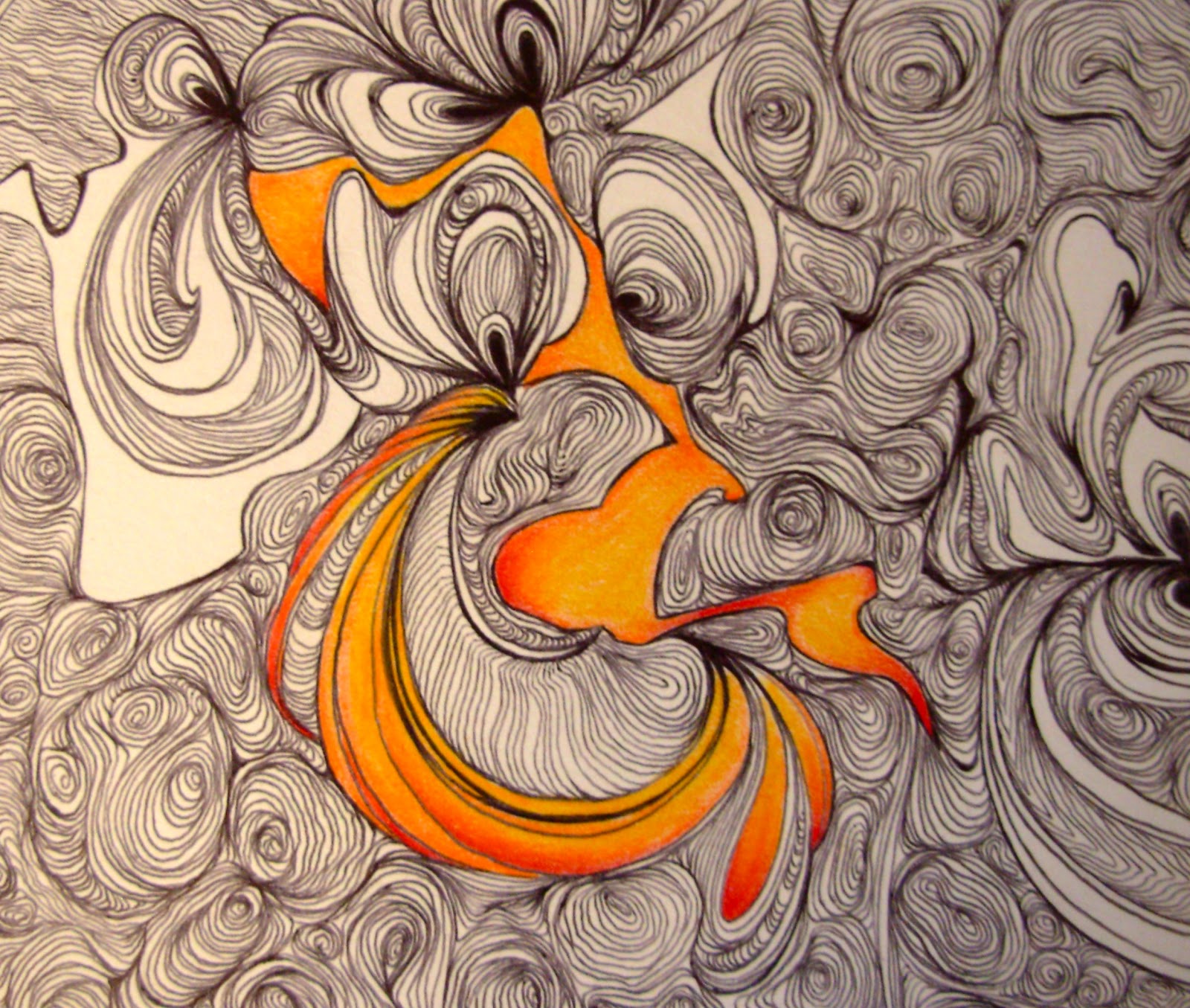
With a little coaxing and last-minute improvisation, it seems the result isn't half bad...an expressive and abstract elaboration on the Pleiades star cluster...


As I may have said on previous occasions, The Pleiades has been a favorite object of mine since before I knew there were such things as open star clusters. I saw it first from the back seat car window during a childhood trip to visit my grandparents in North Dakota. While absent-mindedly gazing up into the dark sky, I was puzzled and intrigued by a little fuzzy patch that eventually resolved itself into what I thought looked like (and this is immediately what I labeled it in the back of my young mind) an "itsy-bitsy-teeny-weenie-yellow-polka-dot -bikini dipper". I smiled and adopted the little patch of stars as my own personal secret constellation...though, of course, I eventually came to find out that it is widely known and much beloved.

I want to reiterate that the drawings in this series are not meant to represent reality in any precise or scientific manner. Though I did use a detailed star map to place most of the "stars" you see in the work, and referenced many astro-photos while adding aspects of nebulosity, my motivation behind all of these works is only to express the sense of the rapture I've felt while viewing the night sky. The astronomical wonders that surround us (whether viewable to the unaided eye, through binoculars or telescopes, or invisible to all but technologies that gather data in wavelengths beyond human perception), and the true stories of creation and cosmic evolution that surround them, inspire my imagination.

March 4, 2013

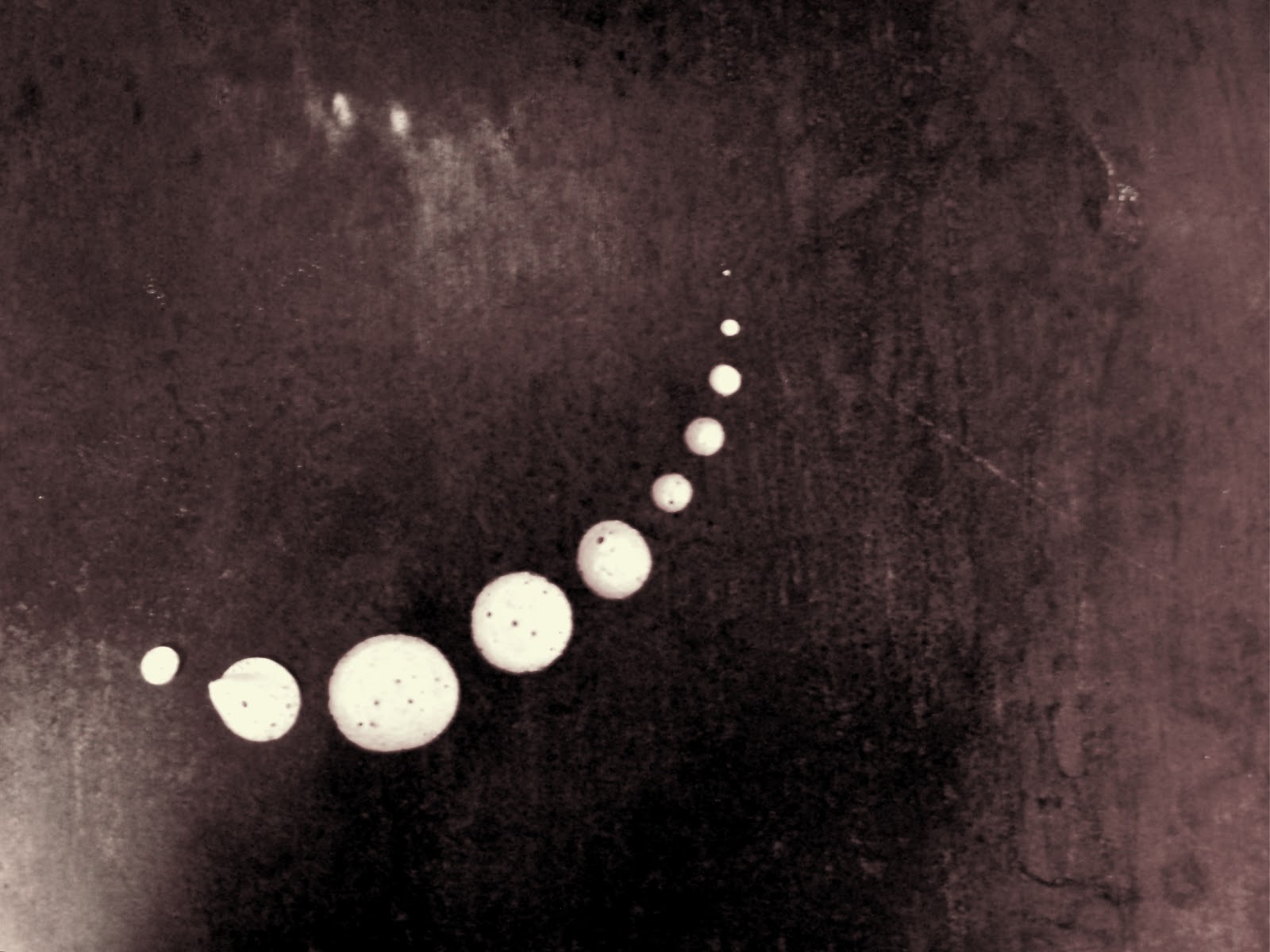
Pancake Corona

Sometimes art sneaks up on you...appearing unexpectedly out of the most mundane of circumstances.

While cleaning up after a pancake breakfast yesterday, I absentmindedly fiddled with the little drops of cooked batter still stuck to the griddle, and ended up with this little sculpture...if you can call it that.


It reminded me first of the Coronas Australis and Borealis: near twin half loops of stars best seen on a clear summer night. Looking again it is a string of pearls that--if I give my imagination a real stretch--appears to recede infinitely into the dark oily tarnish of the griddle.

Guffaw if you like. I'm definitely not the first to explore the aesthetic side of this traditional breakfast fare.


March 2, 2013

March 1, 2013

Virtual Sunsets

One of my favorite ways to doodle away time on the internet is to participate in research based crowdsourceing activities. In particular, I've donated many hours of my free time (which, at the moment, I have in abundance...knock on wood) to various Zooniverse projects: I've identified, counted, and measured craters and other surface features on the moon and Mars, sought out and labeled cosmic bubbles, monitored the sun's surface for ejections of plasma, scanned the skies for distant galaxies and supernovae, and squinted out over the grassy plains of the Serengeti looking for wildlife. In addition to the coolness of getting to flip through images from all over the cosmos, the "busy work" that I and my online "colleagues" complete, often leads to the publication of real scientific papers, and it feels great to think that I've made some small contribution to humanity's search for knowledge. 

As many of you know, when I was a kid (long before I ever made a noise on a trumpet), I told anyone who asked that I wanted to grow up to be "and artist and a scientist," so when I came across a blog post about modern gallery installation involving crowdsourcing, my curiosity was piqued. 

On the surface, Tobias Klein's Virtual Sunset seems a little odd. Gallery visitors are invited to stroll through a hanging cascade of translucent PVC pipes through which light from hundreds of sunset photos create a play of color meant to convey the experience of one gigantic shared sunset. I'm not sure I entirely understand how the physical installation works, but I've found the online portion of the piece--through which all those global sunset pictures are procured--to be a lot of fun. 

Each time a visitor uploads a sunset photo to the project's website, in return they are emailed a composite sunset "mirage" made up of their photo in the center, the nearest sunset at the time of upload on the right, and a "live" sunset image on the left that changes each time you refresh your submission. Examples of my own email "postcards" are shown below...yes, that's right...I got obsessed enough that I uploaded 14 sunsets over the course of the day...I AM getting productive things done in my life...really, I PROMISE

If you've been around since I started my blog you may recognize some of the central images...

Taken on my first trip to the shore of Lake Eerie soon after I moved here...and someplace on the left that I couldn't begin to pronounce...


An evening drive through the Turtle Mountains to Dunseith...with African foliage...


Spray from Niagara...or is that blowing sand...floating through the air above Rio...


A surprisingly exotic view from my apartment in Holladay...


Niagara...with buffalo...


Sure can see a long way from my attic window...


Castle mountain in Graz...


Calm waters in Ithaca...and the Indian Ocean...


This one's kind of a mess...


A SLAS star party...


International Peace Towers...raised over more than one border...


Northwestern reflections...


Bryce Canyon...and a rising Southern star scape...


More hills and tall buildings than I ever expected to see in North Dakota...


It's fun to think that others who submit might get my sunsets merged with theirs, and that for the first time in my life, I'll have my photography displayed in a major gallery...sort of:) It's also interesting to watch my postcards change as sunset moves around the world, and I encourage you to submit sunset photos if you have them.

One thing to keep in mind (that is probably obvious to you, but took me--a tech idiot--a few tries to figure out) is that when you enter the image location into the google maps form on the project website, you can move the little red pin around to the exact spot you were when you took the photo. For example, I took the last photo in the string above at Kelly's Slough National Wildlife Refuge in North Dakota. Well, Kelly's Slough doesn't come up in the location list, but knowing that it's a few miles west of Grand Forks on Highway 2, I just typed in "Grand Forks," and then moved the pin down the highway until I reached the right spot...which I then learned falls within the Blooming township. I guess I'm a little obsessive. Most people probably don't take the trouble.

February 25, 2013

Winter Aconite

Well, as most of you know, the groundhog lied this year. I stopped counting on an early spring a while ago, but here and there some signs of progress can be found.

Beginning all the way back in mid January, these pretty little buds (which I just learned are called Winter Aconite) started popping up around the bases of our trees in both the front and the back yard.


We'd have a warm day or two and more would emerge, only to disappear under thick blankets of snow and ice again, and again. Each time they froze, I'd think to myself, "This time there's no way they'll hold on under all that," but time and again I was proven wrong.

Today the sun came out and is teasing us once again with a bit of warmth, and for the first time, I found that some of the Aconite buds had blossomed...


The weekend forecast is calling for more days of snow, but maybe these optimistic little guys know something the meteorologists have missed.

I'll keep my fingers crossed.

February 18, 2013

Accretion

When I said, way back at the end of November, that I was afraid my latest drawing would take "forever," I  knew I was exaggerating...but I'd hoped that "forever" would actually turn out to mean just one month...not close to three. Since I haven't continued to post any additional "teasers," I'll bet most of you have been thinking I'd given up or trashed the idea...that maybe I should've stuck to my superstitious practice of refusing to show works-in-progress, lest the venture come to naught. But no, I've stuck it out. I've worked on pieces of the three-panelled drawing almost every day since I started (excluding work days at the post office, which leave my hands dry, paper-cut, and achy). My process is excruciatingly slow--three square inches of paper may take an hour or more depending on the level of detail--thank goodness for music and free podcasts! But perhaps this pace is appropriate for the subject matter: the formation of a solar system around a young star...

My first inspiration came from this image of a dust ring around Fomalhaut: the parent star of the first extrasolar planet ever to be imaged in visual wave lengths. I remember when that photo was taken too. I was in my office at Cannonball listening to Science Friday when the announcement was made, and was excited to be able to get to the public library (I didn't have a laptop then) and look it up.


From there I did a few sketches...


...revising ideas and adding details as I went.


...till at last I felt comfortable enough with how things were laid out to block it out for enlargement.


Then came all the painstaking hours, days, weeks...and yes...months of using bic pen and various sizes of sharpies to fill in around the lines. I focused on the central star first, finding inspiration from photos of the sun and its dynamic surface that I found online.

Here are a few of the "teasers" I never got around to posting.


It was a little challenging to work between each panel. My drawing board is only big enough for one at a time so I had to go back and forth between the corner table and my work space, making sure that everything lined up across the board. I made a few mistakes, but ( and remember: with sharpie there's no erasing, and no possibility of painting over--slips must be integrated), I think I dealt with most of them well enough that they make sense in the finished design.

Last night, in between trumpet practice sessions, I finished filling in the last bit of black...


...and then this morning (after forgetting about the holiday and driving down to the post office for work...which of course...I didn't have), I began adding color.


This can be the real make-or-break part. I might be totally thrilled with how the basic black-and-white turned out, only to do something with color that makes it look cheap or corny. In this case, however, I'm reasonably satisfied with the final result (pictured in the first image of this post). 

I haven't really settled on a name yet. I've tossed around a few that sound either too bland: "Young Solar System," or too froofy: "Out of the Dust." "Accretion," the title of this post, seems to be the happy medium I'm almost ready to settle on. The final unframed dimensions, including the space between panels, are 44 x 17 inches. 

I'm looking forward to continuing this artistic exploration of astronomical subjects. I've got it in my head that it would be fun to do a themed show at some point, and maybe even sell a couple pieces. 

But that's a ways off. I'll keep you posted. 

November 30, 2012

If Earth were a Black Hole

A contributor to the Utah Astronomy list serve recently linked its members to an article describing a galaxy whose central super-massive black hole makes up the majority (59%) of the galaxy's mass...and just so you know...that's a lot! You can read the original article here for more details.

In closing, the author asks, "What would you see if you lived on a habitable planet in that far-away galaxy and could look toward the center? Probably nothing that makes sense to human eyes. Black holes have such powerful gravity that they distort the space around them."

Coincidentally, just yesterday, Rob presented an image to his computational modeling class that relates to the above question. It simulates what the Earth would look like to an outside observer if it were 99.99% the density of a black hole...


The first thing that probably grabs your attention is a weird white ring encircling the central continents. Believe it or not, that ring is actually our seventh continent: Antarctica! And if you look closely, you might also notice that the image is so bent and stretched that you can see the Antarctic Peninsula (the arm that stretches up toward South America), twice...and from both directions. If there were a little person waving to us from the tip of that peninsula, we'd see him twice too: his smiling face at the lower left of the image, and the back of his head on the upper right.

By now you've undoubtedly noticed that parts of the other continents show up on the horizons beyond the Antarctic ring: Madagascar and southern Africa up top, Australia on the lower left, New Zealand stretched thin at the bottom, and South America encroaching on the upper right. Amazingly, if we were to increase the density of this Earth even more, the continents would come completely into view outside Antarctica, then Antarctica would appear again...and so on.

One problem is that as this happened, the light would also being severely red shifted. It would eventually reach into infrared  (beyond our visible range), and finally--as we approach an infinite density and our Earth collapses into a black hole--no light would escape at all. Our black-hole Earth would disappear...and we would be wise turn our spaceship around and make towards the next star system as quickly as possible!

November 21, 2012

Just Beginning

Because I'm never sure whether a work I've started will survive through to its successful completion, It's not usually been my habit to share in-progress artwork with others. Though, especially if it's clear the work will take a long time, I have been known to let my excitement to show off overcome any worries of incompletion.

So, yes indeed, I've started another drawing...and this one feels like it's going to take forever! I'm continuing to indulge my recent penchant for astronomical themes, and the subject I've chosen (which I may divulge at a later date), allows for a good deal of creative license. The exciting (and most challenging) thing about this project is that as I began planning it out, I couldn't seem to fit it properly to a single sheet of even the biggest paper I have. Instead, I decided to spread it over three panels. They're not quite as big as the ones pictured here, but in the end, should be at least a little more, well, detailed?

**just a side note: yes, I do think the above three canvases (housed in Paris' Centre Georges Pompidou) constitute a legitimate piece of art. Much as John Cage's infamous "4:33" redefined our concept of "music" and "silence" (there's a great article about this here), these blank canvases set up conditions inviting us to re-imagine how we frame our visual experience, and to consider again that pesky little question that never seems to go away: "what is art?" It took me a long time to appreciate this myself. The first time I went to the Guggenheim in New York and saw similar conceptual and minimalistic works, I was completely aghast. I felt that stuff like this was just thrown together by a bunch of lazy con-artists who were laughing their way into the art-history books. Over time, however, various experiences led me, almost without thinking, to reconsider that initial response, and somewhere along the line I was surprised to hear myself even defending (or in the very least, reserving hasty judgement of), similarly thought-provoking works. Feel free to disagree with me here. I understand why many eyes roll over such pieces (and don't worry, I won't be producing a blank-canvas series any time soon...it's not quite the style through which I best communicate), but you might be surprised what a second glance and a second thought might spark... 

Anyway, here's a snippet of what I worked on yesterday...


I don't have any idea how long the whole piece will take to finish, but I'll likely post more teasers as I make progress.