Showing posts with label family. Show all posts

May 21, 2015

Precession

Lately I find myself thinking a lot about deep time—about thousands and millions and hundreds of millions and billions of years. In discussions of astronomy and geology we toss around those lines of zeros about as casually as we talk about what we had for dinner the night before. I had a Thai-chicken stir-fry, dinosaurs died off 65,000,000 years ago, and the universe is 13,800,000,000 years old…give or take 100,000,000. We’re so used to hearing these big numbers that we don’t really consider what it is that all those zeros stand for, and we forget just how big they are.

Even when we try, it’s really hard for creatures that live only a few decades to even begin to conceptualize what one billion years, or even one thousand years, feels like. So when we think about certain places and events—the carving of the Grand Canyon, the formation of the solar system, the evolution of life—we tend to scratch our heads in disbelief. Rock is hard, how could flowing water carve through a vertical mile of solid rock in only a few million years? Everything in space is so still, how could it be that in just 5 billion years a bunch of gas and dust condensed, swirled, banged around, and then, voila, we have the sun and all the planets? Humans are humans. How could I evolve from something that looked like a fish, or even an ape? Little changes happen, for sure. Maybe some people are taller or shorter, or you inherit your grandfather’s nose, or your mother’s broad shoulders…there’s variation and change, but not enough, and certainly not enough time to transform an amoeba into a walking, talking, thinking human being…is there?

But yes, actually, there’s been plenty of time for all of these things to occur. And the teensy-tiny almost unobservable changes that will become the next epoch’s marvels are happening all around us today. So as I’ve been thinking about deep time, I’ve also started looking for these smaller more human-scale occurrences that can help me account for the passage of years and get a sense for the kind of time that’s wrapped up inside all those zeros.

Yesterday I got into precession.

I learned about precession soon after I got into amateur astronomy several years ago. Someone in SLAS was giving a constellation tour and said that Polaris—the ever-constant North Star, the one little starry beacon that stays put while everything else spins around it—had not always been the North Star. !!!WHAT!!! And not only that, but in another two thousand years, the north star will be Gamma Cephei…some random star in this totally different constellation that I’d never even heard of. My mind was blown.

Our Earth spins on an axis once every 23 hours and 56 minutes. The tilt of that axis is what gives us the seasons, and those lost 4 minutes per spin are what makes the constellations appear to rise and set 4 minutes earlier than they did the day before. Because the Earth is not perfectly round and is constantly tugged on by the sun and the moon, it also wobbles as it spins. Earth is often compared to a spinning top that traces out little circles as it moves across a tabletop. And here I’m always reminded of Leonardo DiCaprio’s character in Inception: the totem he used to tell him whether or not he was dreaming was a little top. If he set it to spin and it wobbled, the world around him was behaving normally, and he knew he was awake. If it didn’t…he was still trapped in a dream world…the dramatic music would go up a notch and we’d all grip our seats a little tighter.


Wobbling is natural. And Earth’s wobble is called precession. As the Earth spins day after day, year after year, century after century, its axis traces out a slow circle across the sky. It takes about 26,000 years for Earth to trace a complete circle and it is purely by chance that at this point in history, our axis happens to be pointing near the 45th brightest star in the sky: Polaris.

26,000 years is a long time to trace a circle, but there’s still enough movement over a short enough period of time that precession has been observed and documented by individual human observers. Yesterday, I wondered if I could find a way to observe it myself. First I wanted to figure out how much the pole should be expected to shift in one year. If the observed change is, say, only an arc second—about the width of a human hair seen from 10 meters away—then forget it…there’s no way I could get that kind of precision with the tools I’ve got on hand*.

*My tools: ruler, pink protractor, bic pens, string, duct tape…you get the idea.

To figure this out, we know there are 360 degrees in a circle, and that it takes 26,000 years to trace them all out. That means there’s a movement of about .014 degrees per year. What does that mean visually? Well, the full moon takes up about .5 degrees in the sky, so we can already see it’s quite a bit smaller than that. How much smaller? Well, there are 60 arc minutes in a degree, and 60 arc seconds in an arc minute. So multiplying our yearly progress of .014 degrees by 60 gives us .84 arc minutes traced per year. Multiply that by 60 and we now have about 50 arc seconds traced per year. 50 arc seconds is about the diameter of Jupiter as seen from Earth…or a little less than the thickness of typical birthday-card stock held at arm’s length. That’s pretty small. But it’s something—especially if my dad keeps sending me birthday cards every year! All those little layers are going to add up.

Now imagine if I had a little more than a century’s worth of precession to work with. That’s more than a typical human lifetime, but it’s still a time span most of us can relate to. At the dawn of the 20th century, there were 1.6 billion people living on Earth, America had only 45 states, automobiles had been around for a decade or so, and the Wright brothers had just made their first flight. It was a pretty different world, but my great grandparents—some of whom I was able to know as a child—would have been kids around that time.

I remember being a kid, and I’ve seen movies of my parents as kids, and my grandparents as young adults. As I age, I understand more and more how time can slip away. One moment you’re in grade school playing on the swings at recess—you think, “I’ll never be old enough to…” drive, or date, or fill in the blank with whatever grown-up dream occupies your fancy. And then suddenly you’re in high school…and then it’s your 10 year high-school reunion…and you’re working and paying bills and dreaming about all those just-yesterdays at recess. You can think of a century as being about three or four generations.  And though technology has advanced rapidly in the last century, I imagine that the experience of living an individual life still feels similar. So, what did the North Star look like to my great-grandparents when they were children? And how does it compare to where I see it today? I decided to Google that…and this is what I found.


A photo published in 1902 of star trails centered on the North Pole, featured in an article by George Ellery Hale.

Another quick Google search yielded numerous spectacular star-trail images from more recent years, including this one from 2012.

It took me quite a while (and a good number of accelerated polar spins in Stellarium) to figure out which stars were which in each image, and was a lot harder than I thought it would be. They both use different exposure lengths, are taken at different times of the night (and probably different seasons of the year), one is color (helpful for figuring out stars), one is not (not helpful for figuring out stars), and both have their own visual idiosyncrasies that conspired to fool my eyes. I finally inverted the colors, which seemed to help, and after enough comparison I was finally able to nail down a few stars.


I used a protractor to find each circle’s center, which marks the location of the true North Pole in each photo. Looking back and forth between the two images, though they’re at slightly different scales, I thought I could see a pretty clear difference in the pole’s location relative to Polaris and the other stars.

But to be sure my eyes weren’t deceiving me, I made a triangle between the same two stars and the North Pole as they appear in both images and measured their angles to see how they'd changed in 110 years.

1902

2012


Though I can’t measure the actual number of degrees the pole moved from the limited information I have in the photos, they do very clearly show that the pole is moving. In fact, In 110 years, the pole has moved about 1.5 degrees closer to Polaris—the diameter of 3 full moons—and it will be as close to Polaris as it can get—a little less than one full moon away—in the year 2100.

Now, I’m not an astronomer and I’m not a mathematician, so to the pros, my little observation here might seem trivial. A real astronomer could do much more calculation than I can muster, but I’ll be honest, I was pretty excited when my measurements showed something!

Try to picture it: in about 200 years, the North Pole changes by about the diameter of 4 full moons. I wasn’t around in 1900 to begin the period of observation I’m focusing on here, but my great-grandparents were. I won’t be around in 2100 to see Polaris make its closest northern approach, but my sister’s kids—one of whom will just be starting kindergarten next fall—just might. By that time, they might even have their own grandkids. That would make me the legendary crazy great-grandaunt (is there such a thing?) that was alive at the turn of the 21st century. So in 200 years—and about 8 generations—there’s a chain of acquaintance and memory (and, yes, these days we also have photos), that bears witness to an observable change in a celestial point that I grew up believing is constant and unchanging.

Now think about this:

In the amount of time that it took for Earth to complete its last full precession:

9,490,000 sunrises warmed the Atlantic coast (though only about 3,600,000 occurred over the eastern shore of Lake Michigan…it only arrived on the scene 10,000 years ago).

26,000 winters melted into spring.

10,400 generations passed on their memories, and humanity advanced from making its first clay pots and fibrous baskets, to sending mobile science laboratories to the surface of Mars.

The rim of what would become Bryce Canyon National Park receded about 6500 feet.

and the Himalayas rose by 1 mile.

And on into the future…

Polaris will precess back into its current position 3,800 more times before Amasia—the next great supercontinent—will form.

9,600 more precessions will occur as the sun makes its next trip around the core of the Milky Way Galaxy.

We’ll get to complete an additional 192,000 precessions before our sun swells into a red giant with a diameter of Earth’s current orbit…and any life that remains on Earth is toast.

And again, my mind is blown.

June 18, 2014

Details


Friday June 13

The skies are darker at Bryce Canyon and the full moon is brighter. In this high elevation, the thin dry desert air is conducive to sunburn and moon blindness. Last night while showing people the nearly full moon through my telescope (using a polarizing filter at its darkest setting), I looked back along the line and perhaps 80% of them had their hands or a hat held up to the side of their face to block the moonlight. As each stepped up to the eyepiece, I did my best to cast a shadow over their faces as they observed.

Though the full moon is the bane of every deep sky observer, I quite enjoyed showing it off. The prominent ray crater Tycho appeared in full bloom—its striking splatters reaching far across the surface, bisecting dark Maria and bright Highlands alike. People's eyes were very naturally drawn to Aristarchus—a brilliant white crater sharply contrasted against the Ocean of Storms—and Grimaldi—a deep gray crater set apart from the larger seas by a swath of highlands. More astute observers enjoyed the shadowy terrain approaching the moon's southernmost edge—the only place that betrayed any sense of depth and topography.

Tonight I'll be leaving the telescope at home to shadow Geoff's full moon hike. One of the most popular programs here at Bryce, these limited Ranger led excursions fill up less than an hour after the visitor center opens in the morning. I'm excited to go wandering below the rim to see how the hoodoos are transformed in the silvery moonlight. Some kind of magic is inevitable!

Saturday June 14

Met up with an old friend for breakfast yesterday morning. Chris (a violist in the Utah Symphony as well as an artist), and I had exchanged a series of art postcards years ago. It was nice to catch up and discuss a few of our recent adventures.

In the afternoon, I quietly barricaded myself in my room, put on some music, and DREW for the first time since I've been here. To a soundtrack of Terry Riley (“A Rainbow in Curved Air,” and “Poppy Nogood and the Phantom Band”), John Adams (“The Wound Dresser,” Christian Zeal and Activity,” “Five Songs by Charles Ives,” and “Eros Piano”), and Sibelius (Symphony #5 and #7), I drew an imagined recollection of an old crescent moon just before sunrise above the varnished cliffs at Calf Creek. It felt FANTASTIC to draw again. I think I've been needing a creative outlet. Though it's just a sketch—done using ball point pen and a touch of pencil—I may decide to do a more polished version when I get home.


The full moon hike was every bit worth the hype. I was assigned to be the Caboose to Geoff's group of 30—bringing up the rear and making sure no one got left behind. On full moon hike nights, a couple telescopes are also set up on the rim so people can view the moon and other bright objects up close when they come back out of the amphitheater. Radar and I grabbed a couple armloads and helped Richard get all his equipment up the hill. It's hard to imagine a more stunning observing platform.


At the beginning of the hike Geoff led the crowd up to a nice spot on the rim near Sunrise Point, gave some safety information, and introduced the focus of his talk—the “superpowers” of Bryce Canyon's nighttime plants and animals. And yes, plants DO have super powers. The Bronze Evening Primrose produces a flower that blooms on only one night. In order to ensure pollination, it virtually glows in ultraviolet and lures in giant moths with a pungent odor. Bats pursue insects (including the giant moth's) using sophisticated sonar. Glow worms—females of a particular species of beetle—light up the back segments of their bodies to help attract mates. Rattlesnakes see in infrared. Great horned owls crush their prey with hundreds of pounds of force in their powerful clutches. And the list goes on. A fascinating topic. I wish I'd been taking notes to help remember more of the specifics.

But before he got in to all of that. Geoff finished his introduction with a dramatic proclamation. “Ladies and Gentlemen...on behalf of the National Park Service...I give you...the Full Moon!” At that moment a bead of crimson broke the horizon over the distant landscape. Oohs and ahhs broke out among the guests as people scrambled for their cameras and the best vantage from which to capture the rapidly rising disc. A windy day had stirred up a lot of dust, and this “Strawberry Moon” was very dark ruddy orange. A spectacular sight above the painted geometries of the high desert.

We continued along the rim for a while and then headed down below on the Fairyland Loop trail toward Tower Bridge, stopping periodically to take note of a particular organism's “superpower” and enjoy Geoff's engaging storytelling. The sky got darker and darker, and the trail along with it. The moon was now behind a ridge and I found myself struggling a bit to place each step securely.

It was right around this time that Geoff started talking about Mountain Lions. They hunt by staking out a heavily used game trail, climbing high up on a nearby ridge, and then pouncing as deer amble by. But they won't go for the first deer in the group. They'll instead wait till a slower one...maybe sick or injured...comes by in the very back of the line, and then go straight for the neck. You can imagine how that made me feel as the designated caboose! When it's made a kill, a lion will drag the carcass high up into a tree. Then for several days it'll eat, guarding it's stash from other scavengers who may try to score an easy meal. A few years ago some visitors went to the rim early in the morning and were horrified to discover a deer hanging high above them in the branches of a tree. They immediately complained saying it was a most cruel and tasteless practical joke. But it was no joke. A crew of wildlife specialists and law enforcement officers armed to the hilt were immediately sent to the scene. A lion kill so near to the park's most heavily trafficked area posed a serious threat to public safety. The deer was removed to a more remote location. A near tragedy averted.

We continued down the trail and finally into the moonlight. Stars were coming out now, and the hoodoos appeared as immense black silhouettes against the bluish night sky. As we approached the “Hoodoo Graveyard,” moonlight struck the great white limestone walls like a spotlight, casting sharp cool shadows, and encouraging the imagination to conjure up a whole host fantastical creatures. Geoff told us of nights he's travelled out to this spot with starlight alone to guide his path—the grand arch of the Milky Way sweeping overhead—bright enough to cast shadows of its own. Even in the full moon light, the sky was full of stars fainter than I'd have guessed. Is that the Milky Way? Or am I just imagining it. Nah...this time it's imagination...I think.

Sunday June 15

Thanks to Dad, Carol, Mal, Ryan, Cid, Zoey, Todd, Yumi, Aaron, Ardis, Joel, Crystal, Robyn, and all the kids for visiting me at Bryce Canyon (and buying me ice cream:) It was great to see you all...even for just a few minutes. 

AND HAPPY FATHER'S DAY DAD!

Tuesday June 17

So much has happened. Too many details to be thorough. Some of the specifics meld into what has become a sort of routine—though in a place like this I hate to use such a word. It's the kind of routine where discovery is the norm. Where I increasingly admire the skill of those with whom I work, and from whom I hope I am learning a trick or two. Where the same places visited day after day never lack for enchantment. A wild Iris on the walk into work distracts my eye so that I almost fail to notice a mother and two baby pronghorns grazing in the morning shadows beneath the pines. I freeze to watch. She stamps her feet and eyes me with a resolve I pray won't lead to a defensive charge. Mother and babies: a lovely...nervous kind of sight I don't know whether to relish or cautiously avoid.


The work comes with its own set of challenges. I make mistakes. Deal with awkwardness and tension here and there. Remind myself (with mixed success) not to complain about trivialities. Take deep breaths. Call Rob for a kind word and a loving ear. Forgive myself for things I could've done better...and then try to do them better next time. Remember to let things come as they may. Take a break now and then.

Yesterday I visited “Spooky” and “Peekaboo,” two slot canyons in the Grand Staircase with Don, one of the Interpretive Rangers here. We stopped in at the Escalante Visitor Center—interesting being on the other side of the desk after weeks of playing informal tour guide—to check on road conditions, hiking maps, and trail information. The Ranger said getting up to Peekaboo would require a moderately technical scramble up about 10 feet of sandstone. The directions I'd read online that morning said it would be more like 20 feet. Sucking in my old nervousness of heights, I pressed for more details. She said we'd have to help each other through a few tough scrambles, but that no ropes would be needed. Don and I were not well acquainted, but I imagined we could muddle through well enough together.

Don is good company. On the surface it seems we both tend toward a quieter approach to interaction. Politely inquisitive. Casually interested without ulterior pressures or motivations. I appreciated being able to probe his deeper knowledge of the area. Glad a more experienced professional would allow me to tag along for a little adventure.

The “Dry Fork Slots,” are located about 27 miles south along the Hole-in-the-Rock Road. It was heavily washboarded and high-clearance vehicles were strongly recommended. I was grateful Don had agreed to drive us in his pickup. A few miles in we made a brief stop at the “Devil's Garden” to wander among a different kind of hoodoo (and take a final bathroom break). Comparatively low to the ground and voluptuously smooth, these wind-carved sandstone hoodoos were an interesting contrast to the towering, brittle, and multi-faceted, rock gardens of Bryce Canyon I've been familiar with of late.


The last stretch of road leading to Dry Fork looked as though it was molded from mounds of clay. All guides state emphatically that the route is impassible after even the slightest rain. On a map, several roads lead south from highway 12 through the Grand Staircase—Hole-in-the-Rock, Cottonwood, Alvey Wash, Smokey Mountain—and look to many visitors like excellent alternative routes to highway 89 south toward Page. Seeing the conditions of these roads firsthand brought home the warnings I'd heard from other Bryce volunteers that one should ALWAYS check in at the GSENM visitor center before using them for travel. Scenic? Yes. Practical? No.

Once parked, we followed a series of large, widely-spaced cairns down a steep slick-rock outcrop. This “trail” leads down to a broad sandy wash into which Dry Fork, Peekaboo, and Spooky canyons empty. Dry Fork is a section of “narrows” (a little wider than a “slot,” but not by much), that can be followed for several miles. Maybe we would check it out on our way back. The entrance to Peekaboo was nearby to the left where a small group of people was clustered about its mouth. A young family who'd just come down its length watched excitedly as a number of twenty-somethings prepared to ascend.


 I looked up at the smooth sculptured sandstone with a bit of trepidation. A series of shallow hand and toe holds were carved into its surface. It was definitely more than 10 feet of climbing. I motioned to Don to go first, hoping to observe his technique. The first bit seemed fine enough. A stone ladder—a quick pivot over a thin vertical ledge—then a gradual chute where a little wedging between hips and feet would carry you up. Don struggled a little, but seemed relatively unfazed by the awkward motions. A knot had built up in the pit of my stomach, but, I thought, if a 67 year old man could manage it,- there's no reason I shouldn't be able to. Right?

A tall energetic German youth arrived suddenly, and virtually leapt up the whole way, stepping right over the top of Don who was just completing the last bit of his ascent. His girlfriend stopped beside me. “He's a real mountain goat!” she said. The German held out a hand to Don and helped him up the rest of the way. He then tossed a rope down to his girlfriend and offered to hoist up both our packs. “It will make it easier to balance,” he encouraged. I gulped and clipped on my pack. It was my turn.

I cautiously stepped up the pile of stones leading to the first toe hold. A little wobbly for my taste. One step. Hmm. Wrong foot. Step down. Switch feet. Start with the left this time. Umm. Still not so comfortable. It looked so easy for the others. Right foot it is then. Ok. Left. Sort of. Hold on. Pull up. Sit down. Ok! Two thirds to go. Take a breath. Now how to manage that pivot. I wish there wasn't so much sand in these toe holds. 6 feet looks a lot taller from up here. Lean into the rock. Swing my body around. Ok, sit! It's so slick! Can't seem to make the wedging work. There's nothing to hold onto. My feet just want to slide. No traction. I can feel the pull of gravity. Not sure where to hold. The smallest shift of weight could send me sliding down to the ground. The German can see my fear and throws me the rope. It's such a thin little thing. Just a string. Holding onto it gives me no assurance. Their hands are only a couple feet from my grasp, but I can't seem to push myself higher. Mom and kids are watching below. “You can do it. Just a little bit higher!” But my legs are shaking now. I can feel my broken bones below. Hear the sound. A dull crack.

“I'm going to make a decision for my own safety. I'm not sure enough on my feet. I should head down.”
“I don't accept that!” insisted the German. “You can do it.”
“I've got to be honest about my ability. If I'm struggling here, it will be worse further up.”
A wave of disappointment.
I resolve to indulge in minimum apology. I won't wallow. This is a practical safety decision. I have to understand and accept the limits of my ability.

With guidance from Mom and kids below, I shakily make my way back down the stone ladder. The German girlfriend takes her turn. Struggles a little, but slowly makes it up. They send down my pack. Don descends. I'm embarrassed, but feel I've made the right decision. I make my apologies, say thank you and good luck to Mom and kids and the German couple. I'm grateful Don seems to be easy going enough to not be too put off by my backing down. “There was a real danger there,” he says reassuringly.

We walk along the sandy edges of the giant mound of rock from which Peekaboo was formed. Climbing slowly now—one step forward, half a step back in the hot slippery sand—we eventually top the sandstone bulge and begin to explore. Cairns! An alternate route around the canyon perhaps? Soon we are looking down into the narrowly winding, knife-edged slot. It's an easy descent to the bottom from here...


...and now I hear voices! Our German friends are squeezing their way through the sculpted zig-zags. “What took you so long?!” I say.

They don't have a map so we share ours, along with the directions for finding Spooky from the upper exit of Peekaboo. Now it's our turn to descend into the zig zag. It's hard to believe that an adult human body is capable of gliding through the contortions of sharp-edged sandstone that lead us deeper into the canyon. We take off our packs and bend, slide, bump, and lean through the one-way maze. 


As the walls rise around us, I imagine a flash flood sweeping through—filling the canyon to its top and rushing over its edges—the water thick with sand and broken bits of brush. We reach a point where Don judges the descent a little too steep—a hoop of rock showing a sandy bottom many feet below— and then head back up the way we came. Here and there I give him a push up from behind, and he offers a hand up in return.

Back down in Dry Fork Wash, we head toward the entrance to Spooky. Temperatures are mercifully mild, but a fierce wind whips up billows of sand that make my teeth grate like sandpaper. The gale is desiccating. I can almost feel the moisture wicked from beneath my skin. What would it be like to travel across this landscape with limited provisions? What must those early pioneers have endured along their journey south to Hole-in-the-Rock—a passage they had to carve out themselves to enable travel by wagon team? 1880. That's not all that long ago. My grandparents would have been old enough to have spoken with someone who made the trip.


 Spooky's entrance is much more inviting—sort of. There's no steep climb. The trail remains level as you enter this slot. But the high walls close in rapidly. Packs must be removed, and travel through the canyon is only possible sideways. Our chests and bellies slide over bumpy sandstone conglomerate. “This is the slottiest canyon I think I've ever been in,” quipped Don. Shadows are deep and hues of reflected light cast an eerie glow over the rock. Spooky indeed!

...and not ideal for hand-held photography as you can see from the blurry pictures...just think of them as action shots!


Voices ahead. Our German friends once again. We hurry to a slightly wider cutout in the rock and allow the couple to pass. Smiles all around. Continuing on there's a hint of...music? We meet a photographer with tripod set for a long exposure, earbuds in, no doubt preparing to take a classic shot of light cascading over elegant sandstone curves.


I honestly never thought I'd actually be able to see one of these picture-postcard desert-calendar slot canyons in person. I'd always assumed that the photos I'd seen were captured in secret corners of wilderness shared only among elite climbers, adventurers...people infinitely more well-equipped and more in-the-know than little old me. But I am actually here. Feeling the rough stone scrape my skin. Willfully trapped within a world of pale light, rich shadow, and fanciful geometry, lit by nothing more than a thin line of deep blue overhead. Looking way up we see huge boulders suspended in mid fall. Wedged between the canyon walls, piles of plant debris has collected around each point of contact—a sobering reminder of the violent floods whose currents carved out this channel just wide enough for a medium-sized adult to navigate.


Finally we reached a point where further squeezing might have caused torn shirts and uncomfortable scrapes. I can't say we turned around—there wasn't room for that—we just reversed our sideways shimmy and headed out the way we came.

The climb up was hot, sandy, sunbaked, guesswork. I downed the last of my water, happy knowing I had a third full bottle back in the truck. At one point we lost the trail of cairns, so just kept climbing till we reached the top of the hill and could see the parking lot in the distance. Stepping gingerly so as to avoid the fragile cryptobiotic soil growing all around us, we made it back. My water was hot enough to brew tea and tasted like plastic, but who's complaining? After another noisy bumpy drive up the road, we rewarded ourselves with cold drinks and pizza at Escalante Outfitters, and relaxed to an old tape recording of “The Hobbit” on our way home. In spite of my embarrassing bout of acrophobia, it turned out to be a very enjoyable and rejuvenating day. Thanks Don for the idea and the invitation!

July 25, 2013

Utah Visit, July 2013, #7: all the rest

I've now run out of pictures, and feel like I haven't even told you the half of it. I guess I covered all the big super-adventures, but still failed to mention all the other important stuff.

Like the wonderful time I spent on walks with my mom, and pushing fully laden flat beds up Costco's parking-lot hill to equip her truck for a job on the Salt Flats...hanging out at home with my youngest sister and her adorable (and growing) family...meeting my sister Shaun's new husband (a winner for sure)...and all of us preparing home-made pasta with home-grown sauce fixin's, and playing board games together around the dining room table...board games created and published by my incredibly talented brother-in-law Ryan (find and purchase them on Amazon, or at Red Raven Games).

I didn't tell you about looking at Saturn through a borrowed C-8, seeing old SLAS friends at Denny's and Harmon's, or staring at the enormously bright double rainbow that shone above the mountain foothills during an evening rainstorm in the final few hours of my stay.

I didn't even mention the drive up to Brighton with Mal and her two kids...we spent a lovely hour strolling around Silver Lake...watching the ducks, admiring (and in Zoe's case tasting) the pretty rocks, and saying hello to Mickey Mouse on Mount Millicent...now, why in the world didn't I take any pictures of that?


I didn't mention that I missed seeing all my old music buddies...wished I could've spent a day or two more with Dad to visit Grandpa Ricks in Idaho...couldn't squeeze in a visit to the Salt Flats...or Antelope Island...or Timpanogos...or any one of a thousand other sites around the state...

...sigh...

I took the red-eye back to Cleveland, stepped out into another hot and muggy Ohio sunday, and puttered around at home till Rob returned from Poland later that evening. After dinner he pulled out his phone and showed me all the pictures he'd taken in Warsaw: the city, conference sites, and a few of the famous physicists with whom he'd shared the week. I blushed as he pulled out a gift...a gorgeous amber necklace...just my style.

Real life has descended again...and to be sure, there's lots of good in it as well. The long-overdue visit to Utah gave me a shot of much-needed vigor, and I hope it doesn't take me quite so long to muster a future return. In the meantime, I'll keep looking for ways to discover the best in what's around me here and now. Thank goodness for those fireflies! And BRAS, Oasis, baby groundhogs, fields of daisies, the metroparks, fresh chévre, backyard deer (and baby deer too!), free Oberlin Conservatory concerts, cardinals, goldfinches, bluebirds, orioles, the Ritchie Ledges (I should write a post about them soon), full moon walks at the Wellington Reservation, early-morning ground fog, spring peepers, the Cleveland Orchestra, albino squirrels...and all the other cute little squirrels and chipmunks and bunnies for that matter...

Ok, I'm out of breath. But I think you get the idea.

Thank you again to those who enabled my Utah visit, and all the rest of you that helped make it so memorable.

July 24, 2013

Utah Visit, July 2013, #6: Spiral Jetty

Even though a long drive and late night conversation kept me up into the wee hours, the morning after my return from Bryce Canyon came early. I spent the night on Patrick's hide-a-bed couch to avoid driving home groggy, and had hoped to sleep in, but (as is so often the case for me), my eyes popped right open bright-and-early a little before 8:00. Not wanting to disturb my nocturnal host, I quietly grabbed some breakfast, cleaned up my sleeping area, and made my way back to Salt Lake. My dad and I had planned another day together...this time to check in on another of my favorite Utah destinations: Robert Smithson's "Spiral Jetty."

Because it's an interesting visit and right on the way, we also pulled in first for a quick look at the Golden Spike National Monument. As luck would have it, we were right on time for one of their daily steam-engine demonstrations. Working replicas of the two engines that met face-to-face when the Union and Central Pacific rail lines were joined in 1869 still sit atop the rails in lavish Victorian finery...a striking presentation in the otherwise sparse and semi-arid landscape. Several times throughout the day, each of the two engines takes a turn traveling up and down the tracks giving visitors the chance to see and hear the powerful machines in operation.

We arrived only minutes before the Union Pacific 119 was to take its turn in the spotlight. Costumed volunteers climbed aboard the engine and waved at the small crowd of spectators. Steam hissed as polished wheels chugged their cargo slowly backward to a point where an alternate track would allow it to steam forward for a second pass. During the display, a park ranger related the history of the transcontinental railroad, and explained features of the engine and its operations. He cautioned us repeatedly to prepare for the whistle blows...and for good reason! With each tug of the chain a Tooooot-TOOOOOOOOOOT all but exploded from the powerful whistle, sending the sound reverberating off distant hills, and the thrill of goosebumps up my arms.


Stimulated by such sights and sounds, it seemed easy to imagine how things might have felt when Utah was young and the railroad was in its heyday.

And then it was off to the Spiral...

During one of Rob's visits a few years ago we decided to make trip in order to admire both Smithson's genius, and the work of Rob's uncle Bob Phillips...the foreman contracted to move all those  tons of black basalt into place. We braved the rough and washed-out road to Rozel Point as far as it would safely take us. The bumps and ditches eventually got too big for my little Yaris (not a vehicle I'd recommend for off-roading), and forced us to walk the last mile or two. The sun was really beating down that day, and as neither of us had visited the site before, we weren't even sure how far we'd have to walk to get there. As we rounded the point and caught our first glimpse of the immense spiral hovering above a shallow pool of almost ridiculously pink water, it was easy to forget the heat and lose ourselves in the structure's odd beauty.

This time 'round, Dad and I lucked out. Since that first visit, the road approaching the Spiral had been repaired well enough that we would've made it the whole way just fine...even without the nice tall pickup we drove that day. The route to Rozel travels through miles of wide-open privately-owned ranch land, little of which has changed since the artist's exploratory trip to the site in the late 1960s.
...we went down a dirt road in a wide valley. As we traveled, the valley spread into an uncanny immensity unlike the other landscapes we had seen. The roads on the map became a net of dashes, while in the far distance the Salt Lake existed as an interrupted silver band. Hills took on the appearance of melting solids, and glowed under amber light... 
--An excerpt from Smithson's writings reprinted in Robert Smithson: Spiral Jetty 
After crossing the final cattle guard, Dad and I continued south along a dusty sunflower-lined gravel road. We could see the lake off in the distance...an alluring pinkish-violet wall glittering above the expansive salt flat, baked bone-white under the sweltering sun. I wondered how the Jetty would look this time...black rock left sitting high-and-dry above a receded lake? Submerged and barely visible under a translucent curtain of water and brine shrimp? Corrupted by vandals? How much would natural entropy...a vital component in much of Smithson's work...have altered the site since I'd seen it last?

As it turned out, the Jetty appeared much the same as I remember...with a few surprises...


The water may have been a tad higher overall, and maybe even a more vibrant pink...


...puffs of foam (a result of wave action stirring up natural surfactants in the water), played alongside golden swirls of pollen floating on the surface...


With some well-placed steps over pools of colorful brine, we were able to walk the length of the spiral and admire its up-close charms...


...making sure to stop from time to time to admire a wider view...


...island mirages floating along the horizon...distant clouds reflecting in shallow water...


...flocks of pelicans flying in to shore, their huge wings whirring above us, radiant in the sunshine.


Our energy spent, we got back in the pickup and headed back home.

I was tired and a tad grumpy due to lack of sleep, but grateful once again to be back in Utah...this land of such varied and unexpected treasure...territory that has played host to so many peculiar moments of history, and continues to inspire hope and creativity among those fortunate enough to pass within its borders.

July 19, 2013

Utah Visit, July 2013, #4: White Pine Lake

Early on in the hike up to White Pine Lake, a hazy Salt Lake Valley, rimmed on its western edge by the Oquirrh Mountains, becomes visible above Little Cottonwood's gaping granite mouth. It's a great place to stop for a breath of clean, pine-spiced, mountain air.

My had dad picked me up earlier that morning in order to get a good shady start up the trail before the sun crested the upper ridges. We took things slow. I'd been exercising regularly in preparation, but knew the altitude (about 10,000 feet at the lake) would likely cramp whatever small advantage I may have gained, and anyway, we were not hiking for speed, but for the enjoyment of being outside together in such a glorious environment. In the first few hundred feet we'd passed through a stand of young aspens: regrowth after an avalanche tore down the slopes years before, leaving behind a silent river of fallen trees and intimidating boulders. Little ground squirrels fearlessly darted across our path, while deer and moose who'd passed by earlier left tell-tale prints for us to admire in the wet black earth.

Technically, White Pine, one of three alpine-lake ascents that branch out from a single trailhead, poses only minor difficulty (at least for those with some level of fitness), but it meanders through an exquisite variety of mountain environments...from dark stands of pine...


...to rolling flowered meadows...


...to stark slopes of sheer rock and fallen boulders that remain frosted with patches of snow well into the summer.


 It is well worth the trip for seasoned mountaineers and weekend trekkers alike. If at all possible, I recommend going early on a Monday morning, as we did. The trailhead parking lot--filled to overflowing on most weekends and weekday afternoons--was virtually empty when we arrived, and until the last few minutes of our descent we saw only 4 other hikers. Blissful...and uncommon...solitude!

The last mile or so of the trail--though it also happens to be the steepest and the most exposed to the punishing UV of high-altitude sunlight--is definitely my favorite. It criss-crosses a vast talus slope and offers ever-broadening views of the peaks that surround the lake, as well as the colorfully-layered slopes of Little Cottonwood's northern rim.


For a sense of scale, see if you can spot the two hikers in the photo below...they're walking on ahead of us just right of center.


Vegetation in the area is sparse, but if you keep your eyes peeled, colorful surprises are waiting to be found...hidden gardens thriving in the shade of massive granite boulders.


We were both huffing and puffing over that last bit of trail. My muscles felt fine, but my lungs were working in overdrive. It's shocking how much more exertion is required approaching 10,000 feet...at least for one not acclimated to thin air. We stopped every 50 feet or so to catch a breath and look back over the stunning vista...one advantage to a somewhat limited fitness level, I suppose.

The trail reaches a high point on the slope, and then finally leads back down to the lake. That first glimpse of sapphire and green against a distant wall of jagged red peaks really takes your breath away...if you have any left by that point that is!


The view opposite the lake along the trail's final descent

We unpacked some trail mix and settled in atop perfect granite "picnic tables" for a light lunch by the lakeshore. White Pine, which is dammed on its northern edge as part of the valley's watershed, was as full as I've ever seen it. 


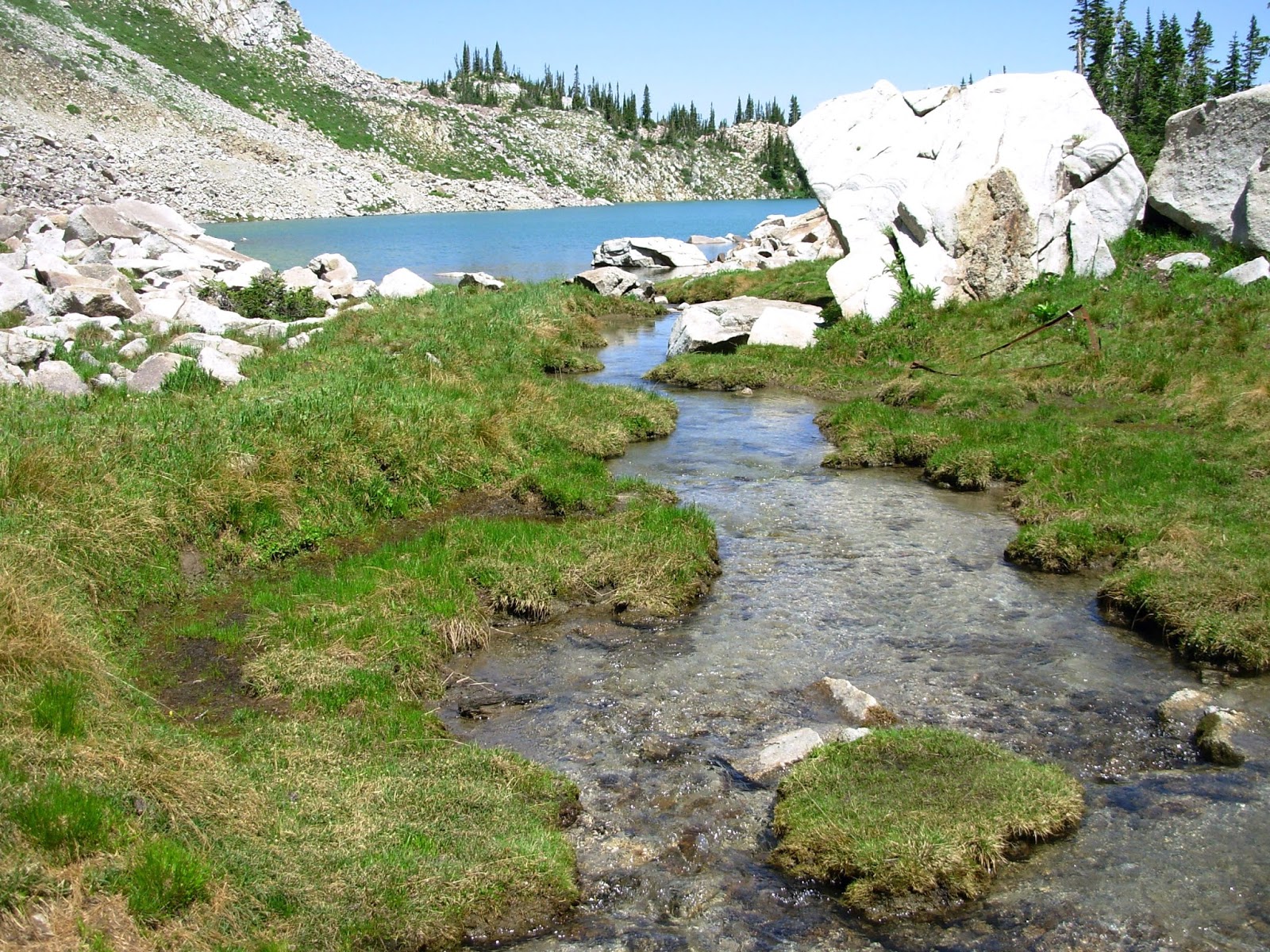
It is fed by at least one little mountain stream that babbles down from the slopes above...likely picking up a  bit of volume from hidden springs here and there along the way.


I was surprised by just how green everything was...I remembered the cloudburst I'd encountered the previous afternoon...looks like it's been a good wet year so far.


Earlier that morning I'd decided to leave my sketchbook behind, thinking we probably wouldn't stay long enough for me to put it to good use, but as I scanned the almost faerie-land-ish ambiance of the country around me, I regretted that decision.


It turns out we had plenty of time to linger. Dad wandered a bit, and then laid down for a brief nap. I found a perch above the shallow stream and watched patterns of light bubble and dance in the crystal water.


I remembered all the times I'd come up here to escape the stress and sometimes loneliness of day-to-day hustle and bustle. Somehow, those pressures and desires could never quite follow me up into these quiet mountain havens. Thus unencumbered, I was left to sense purely, and to dream wildly. It's naive to assume that dangers don't exist up here...that everything's just simple and carefree...or that the worry and emptiness won't catch up again as you head back into "the real world." But I treasure these brief retreats of spirit and imagination all the same...and opportunities to find them are plentiful in Utah.

"Utah is the state by which I came into the West: the place that as an artist was best for me...I wanted to find a land, a place, large enough to hold the feelings I held about the world, about this life we've been given. I wanted to explore what was possible, not just probable. I wanted more space in both the imagination and beneath my feet. And Utah's red wilderness and its forests had, and still have for me, the beautiful density of reality I was seeking: a density and grounding that in turn allowed my imagination to wander."  

   --Rick Bass, excerpted from his essay in Testimony (see recommended books at right)

White Rocky-Mountain Columbine

Eventually it was time to head home. We wandered down the mountain, speaking minimally, stopping only occasionally to admire a chance miracle of color...