Well, as most of you know, the groundhog lied this year. I stopped counting on an early spring a while ago, but here and there some signs of progress can be found.
Beginning all the way back in mid January, these pretty little buds (which I just learned are called Winter Aconite) started popping up around the bases of our trees in both the front and the back yard.
We'd have a warm day or two and more would emerge, only to disappear under thick blankets of snow and ice again, and again. Each time they froze, I'd think to myself, "This time there's no way they'll hold on under all that," but time and again I was proven wrong.
Today the sun came out and is teasing us once again with a bit of warmth, and for the first time, I found that some of the Aconite buds had blossomed...
The weekend forecast is calling for more days of snow, but maybe these optimistic little guys know something the meteorologists have missed.
I'll keep my fingers crossed.
February 25, 2013
February 18, 2013
Accretion
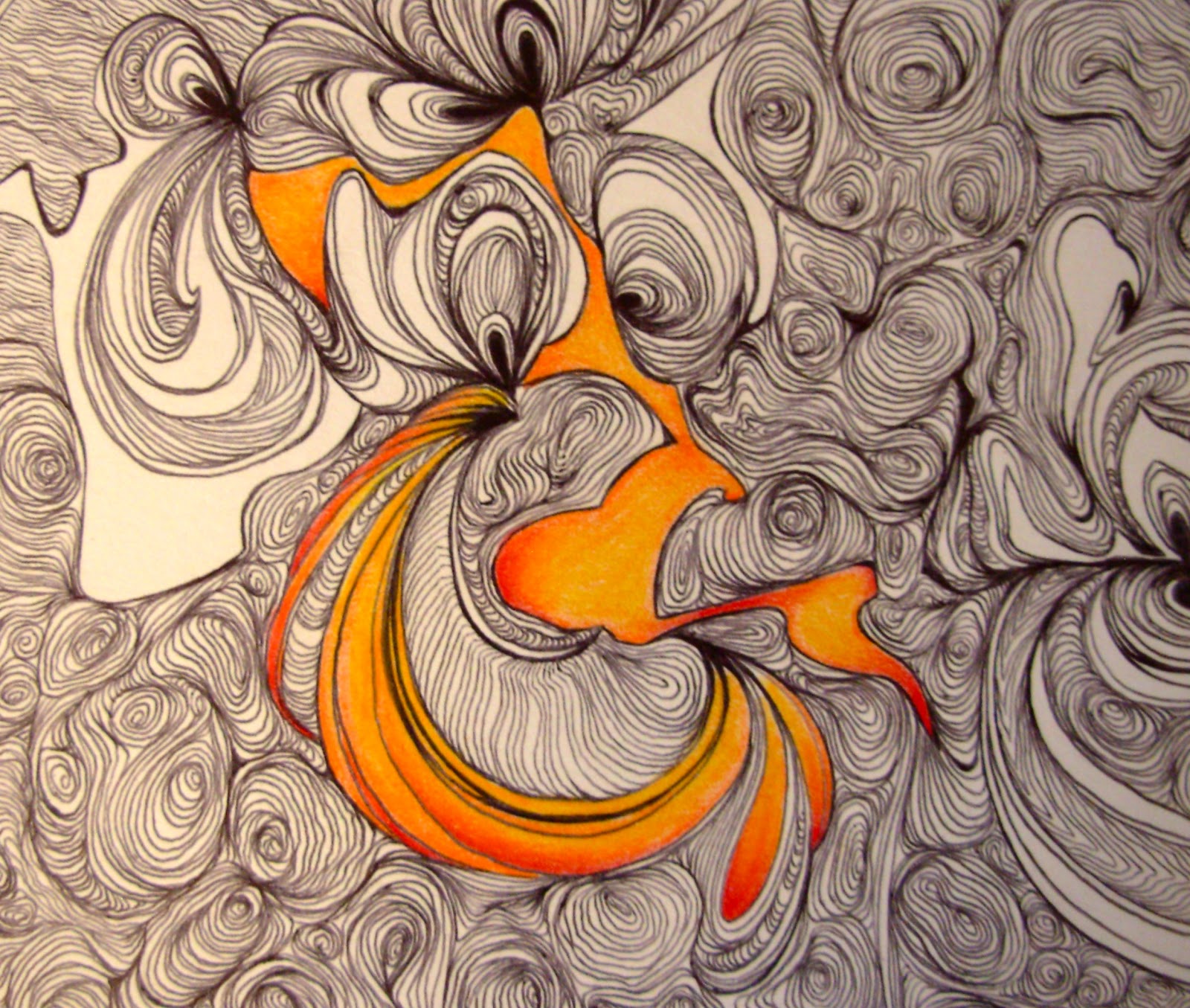
When I said, way back at the end of November, that I was afraid my latest drawing would take "forever," I knew I was exaggerating...but I'd hoped that "forever" would actually turn out to mean just one month...not close to three. Since I haven't continued to post any additional "teasers," I'll bet most of you have been thinking I'd given up or trashed the idea...that maybe I should've stuck to my superstitious practice of refusing to show works-in-progress, lest the venture come to naught. But no, I've stuck it out. I've worked on pieces of the three-panelled drawing almost every day since I started (excluding work days at the post office, which leave my hands dry, paper-cut, and achy). My process is excruciatingly slow--three square inches of paper may take an hour or more depending on the level of detail--thank goodness for music and free podcasts! But perhaps this pace is appropriate for the subject matter: the formation of a solar system around a young star...
My first inspiration came from this image of a dust ring around Fomalhaut: the parent star of the first extrasolar planet ever to be imaged in visual wave lengths. I remember when that photo was taken too. I was in my office at Cannonball listening to Science Friday when the announcement was made, and was excited to be able to get to the public library (I didn't have a laptop then) and look it up.
...revising ideas and adding details as I went.
...till at last I felt comfortable enough with how things were laid out to block it out for enlargement.

Then came all the painstaking hours, days, weeks...and yes...months of using bic pen and various sizes of sharpies to fill in around the lines. I focused on the central star first, finding inspiration from photos of the sun and its dynamic surface that I found online.
Here are a few of the "teasers" I never got around to posting.
It was a little challenging to work between each panel. My drawing board is only big enough for one at a time so I had to go back and forth between the corner table and my work space, making sure that everything lined up across the board. I made a few mistakes, but ( and remember: with sharpie there's no erasing, and no possibility of painting over--slips must be integrated), I think I dealt with most of them well enough that they make sense in the finished design.
Last night, in between trumpet practice sessions, I finished filling in the last bit of black...
...and then this morning (after forgetting about the holiday and driving down to the post office for work...which of course...I didn't have), I began adding color.
My first inspiration came from this image of a dust ring around Fomalhaut: the parent star of the first extrasolar planet ever to be imaged in visual wave lengths. I remember when that photo was taken too. I was in my office at Cannonball listening to Science Friday when the announcement was made, and was excited to be able to get to the public library (I didn't have a laptop then) and look it up.
From there I did a few sketches...
...revising ideas and adding details as I went.
...till at last I felt comfortable enough with how things were laid out to block it out for enlargement.
Then came all the painstaking hours, days, weeks...and yes...months of using bic pen and various sizes of sharpies to fill in around the lines. I focused on the central star first, finding inspiration from photos of the sun and its dynamic surface that I found online.
Here are a few of the "teasers" I never got around to posting.
It was a little challenging to work between each panel. My drawing board is only big enough for one at a time so I had to go back and forth between the corner table and my work space, making sure that everything lined up across the board. I made a few mistakes, but ( and remember: with sharpie there's no erasing, and no possibility of painting over--slips must be integrated), I think I dealt with most of them well enough that they make sense in the finished design.
Last night, in between trumpet practice sessions, I finished filling in the last bit of black...
...and then this morning (after forgetting about the holiday and driving down to the post office for work...which of course...I didn't have), I began adding color.
This can be the real make-or-break part. I might be totally thrilled with how the basic black-and-white turned out, only to do something with color that makes it look cheap or corny. In this case, however, I'm reasonably satisfied with the final result (pictured in the first image of this post).
I haven't really settled on a name yet. I've tossed around a few that sound either too bland: "Young Solar System," or too froofy: "Out of the Dust." "Accretion," the title of this post, seems to be the happy medium I'm almost ready to settle on. The final unframed dimensions, including the space between panels, are 44 x 17 inches.
I'm looking forward to continuing this artistic exploration of astronomical subjects. I've got it in my head that it would be fun to do a themed show at some point, and maybe even sell a couple pieces.
But that's a ways off. I'll keep you posted.
November 30, 2012
If Earth were a Black Hole
A contributor to the Utah Astronomy list serve recently linked its members to an article describing a galaxy whose central super-massive black hole makes up the majority (59%) of the galaxy's mass...and just so you know...that's a lot! You can read the original article here for more details.
In closing, the author asks, "What would you see if you lived on a habitable planet in that far-away galaxy and could look toward the center? Probably nothing that makes sense to human eyes. Black holes have such powerful gravity that they distort the space around them."
Coincidentally, just yesterday, Rob presented an image to his computational modeling class that relates to the above question. It simulates what the Earth would look like to an outside observer if it were 99.99% the density of a black hole...
The first thing that probably grabs your attention is a weird white ring encircling the central continents. Believe it or not, that ring is actually our seventh continent: Antarctica! And if you look closely, you might also notice that the image is so bent and stretched that you can see the Antarctic Peninsula (the arm that stretches up toward South America), twice...and from both directions. If there were a little person waving to us from the tip of that peninsula, we'd see him twice too: his smiling face at the lower left of the image, and the back of his head on the upper right.
By now you've undoubtedly noticed that parts of the other continents show up on the horizons beyond the Antarctic ring: Madagascar and southern Africa up top, Australia on the lower left, New Zealand stretched thin at the bottom, and South America encroaching on the upper right. Amazingly, if we were to increase the density of this Earth even more, the continents would come completely into view outside Antarctica, then Antarctica would appear again...and so on.
One problem is that as this happened, the light would also being severely red shifted. It would eventually reach into infrared (beyond our visible range), and finally--as we approach an infinite density and our Earth collapses into a black hole--no light would escape at all. Our black-hole Earth would disappear...and we would be wise turn our spaceship around and make towards the next star system as quickly as possible!
In closing, the author asks, "What would you see if you lived on a habitable planet in that far-away galaxy and could look toward the center? Probably nothing that makes sense to human eyes. Black holes have such powerful gravity that they distort the space around them."
Coincidentally, just yesterday, Rob presented an image to his computational modeling class that relates to the above question. It simulates what the Earth would look like to an outside observer if it were 99.99% the density of a black hole...
The first thing that probably grabs your attention is a weird white ring encircling the central continents. Believe it or not, that ring is actually our seventh continent: Antarctica! And if you look closely, you might also notice that the image is so bent and stretched that you can see the Antarctic Peninsula (the arm that stretches up toward South America), twice...and from both directions. If there were a little person waving to us from the tip of that peninsula, we'd see him twice too: his smiling face at the lower left of the image, and the back of his head on the upper right.
By now you've undoubtedly noticed that parts of the other continents show up on the horizons beyond the Antarctic ring: Madagascar and southern Africa up top, Australia on the lower left, New Zealand stretched thin at the bottom, and South America encroaching on the upper right. Amazingly, if we were to increase the density of this Earth even more, the continents would come completely into view outside Antarctica, then Antarctica would appear again...and so on.
One problem is that as this happened, the light would also being severely red shifted. It would eventually reach into infrared (beyond our visible range), and finally--as we approach an infinite density and our Earth collapses into a black hole--no light would escape at all. Our black-hole Earth would disappear...and we would be wise turn our spaceship around and make towards the next star system as quickly as possible!
November 21, 2012
Just Beginning
Because I'm never sure whether a work I've started will survive through to its successful completion, It's not usually been my habit to share in-progress artwork with others. Though, especially if it's clear the work will take a long time, I have been known to let my excitement to show off overcome any worries of incompletion.
So, yes indeed, I've started another drawing...and this one feels like it's going to take forever! I'm continuing to indulge my recent penchant for astronomical themes, and the subject I've chosen (which I may divulge at a later date), allows for a good deal of creative license. The exciting (and most challenging) thing about this project is that as I began planning it out, I couldn't seem to fit it properly to a single sheet of even the biggest paper I have. Instead, I decided to spread it over three panels. They're not quite as big as the ones pictured here, but in the end, should be at least a little more, well, detailed?
**just a side note: yes, I do think the above three canvases (housed in Paris' Centre Georges Pompidou) constitute a legitimate piece of art. Much as John Cage's infamous "4:33" redefined our concept of "music" and "silence" (there's a great article about this here), these blank canvases set up conditions inviting us to re-imagine how we frame our visual experience, and to consider again that pesky little question that never seems to go away: "what is art?" It took me a long time to appreciate this myself. The first time I went to the Guggenheim in New York and saw similar conceptual and minimalistic works, I was completely aghast. I felt that stuff like this was just thrown together by a bunch of lazy con-artists who were laughing their way into the art-history books. Over time, however, various experiences led me, almost without thinking, to reconsider that initial response, and somewhere along the line I was surprised to hear myself even defending (or in the very least, reserving hasty judgement of), similarly thought-provoking works. Feel free to disagree with me here. I understand why many eyes roll over such pieces (and don't worry, I won't be producing a blank-canvas series any time soon...it's not quite the style through which I best communicate), but you might be surprised what a second glance and a second thought might spark...
Anyway, here's a snippet of what I worked on yesterday...
I don't have any idea how long the whole piece will take to finish, but I'll likely post more teasers as I make progress.
So, yes indeed, I've started another drawing...and this one feels like it's going to take forever! I'm continuing to indulge my recent penchant for astronomical themes, and the subject I've chosen (which I may divulge at a later date), allows for a good deal of creative license. The exciting (and most challenging) thing about this project is that as I began planning it out, I couldn't seem to fit it properly to a single sheet of even the biggest paper I have. Instead, I decided to spread it over three panels. They're not quite as big as the ones pictured here, but in the end, should be at least a little more, well, detailed?
**just a side note: yes, I do think the above three canvases (housed in Paris' Centre Georges Pompidou) constitute a legitimate piece of art. Much as John Cage's infamous "4:33" redefined our concept of "music" and "silence" (there's a great article about this here), these blank canvases set up conditions inviting us to re-imagine how we frame our visual experience, and to consider again that pesky little question that never seems to go away: "what is art?" It took me a long time to appreciate this myself. The first time I went to the Guggenheim in New York and saw similar conceptual and minimalistic works, I was completely aghast. I felt that stuff like this was just thrown together by a bunch of lazy con-artists who were laughing their way into the art-history books. Over time, however, various experiences led me, almost without thinking, to reconsider that initial response, and somewhere along the line I was surprised to hear myself even defending (or in the very least, reserving hasty judgement of), similarly thought-provoking works. Feel free to disagree with me here. I understand why many eyes roll over such pieces (and don't worry, I won't be producing a blank-canvas series any time soon...it's not quite the style through which I best communicate), but you might be surprised what a second glance and a second thought might spark...
Anyway, here's a snippet of what I worked on yesterday...
I don't have any idea how long the whole piece will take to finish, but I'll likely post more teasers as I make progress.
November 15, 2012
Colder Than...
I've been complaining a lot about the cold lately. Probably more than I ought to, considering how much of the cold season still lies ahead. But I felt some sense of justification this morning when I checked my Weather Channel daily forecast page...
Yes, that's right: Oberlin's temperatures this morning were lower than those at McMurdo Station in Antarctica.
This isn't entirely surprising. It's approaching summer at the south pole and the sun is in the sky all day long. It was about 2:00 AM in Antarctica (8:00 AM here) when I checked the forecast, but the sun had still been hanging around all night long warming things up. If you include costal and interior readings, Antarctic temperatures can soar to the mid 50s during the summer (never mind that they regularly plunge below -100 degrees in the winter), so I'm sure they're going to continue to beat us on our high temps for a good while yet.
As to why I have this particular collection of locations on my daily weather page...so, Oberlin is home, Salt Lake is...also home, and McMurdo...well, a visit to Antarctica has been on my bucket list for years now. It's fun to see its weather details pop up in the morning and imagine that I might someday find a way to make the voyage.
And yet, I complain about the cold. How embarrassing.
I'm really gonna have to toughen up!
Yes, that's right: Oberlin's temperatures this morning were lower than those at McMurdo Station in Antarctica.
This isn't entirely surprising. It's approaching summer at the south pole and the sun is in the sky all day long. It was about 2:00 AM in Antarctica (8:00 AM here) when I checked the forecast, but the sun had still been hanging around all night long warming things up. If you include costal and interior readings, Antarctic temperatures can soar to the mid 50s during the summer (never mind that they regularly plunge below -100 degrees in the winter), so I'm sure they're going to continue to beat us on our high temps for a good while yet.
As to why I have this particular collection of locations on my daily weather page...so, Oberlin is home, Salt Lake is...also home, and McMurdo...well, a visit to Antarctica has been on my bucket list for years now. It's fun to see its weather details pop up in the morning and imagine that I might someday find a way to make the voyage.
And yet, I complain about the cold. How embarrassing.
I'm really gonna have to toughen up!
November 13, 2012
Star Hopping
Though temperatures are now dipping toward the wintery end of the scale, this past Saturday was as lovely a late fall day as you could imagine. The sun (which has mostly been in hiding these days), was out in full splendor, and warmed things up from the low-40s, to a downright balmy 70 degrees. Though I'd seen this optimistic forecast, when I left the house that morning to head in to my job at the post office, I was decked out in a fleecy jacket over the top of a long black turtle-neck sweater. A few minutes into my route I was a lot more than just comfortably toasty in the LLV, and wished I'd worn a short-sleeve shirt underneath. Even with the heat off and the windows down, I was sweating enough to ruin the gas receipt I had put in my back pants pocket...much to the chagrin of the postmaster. Still, I earned some brownie points by completing my delivery in 10 hours: just 1 hour over the route's official evaluation. For a newbie such as myself, that is not so bad. Right now, as I'm learning the ins and outs of casing and delivering the route, I'm paid by the hour, but in a month this grace period will end and I'll be paid for the evaluated 9 hours, whether the route takes me 6 or...heaven forbid...16. It's to my benefit to learn quickly and work efficiently.
The warm clear day turned into a relatively warm clear night: perfect for dragging out binoculars (which we won in a recent BRAS raffle), and a new (borrowed) Dobsonian telescope for some exploring. We brought everything onto the front porch, which offers a nice tree-framed view of the eastern sky, and immediately set our sights on the night's dominant attraction.
Jupiter was perfectly situated above the trees and far outshone it's Tauran neighbors. In a good pair of binoculars, the giant planet and its moons (three of which were visible that night), are a wondrous sight. I should've had no trouble homing in on the celestial beacon with my scope, but unfortunately this particular piece of equipment isn't equipped with a telrad or even a finder. My only option was to sight down the tube and hope to get close enough that slight searching movements while looking through eyepiece would be necessary to locate my target. It took me a couple tries...and a little help with a laser pointer...but was well worth the effort. With an increase in magnification, I was able to pick out three distinct bands of red belting the planet's tangerine disc--the most I'd seen previously had been two.
Later, we took turns checking out a few open star clusters through the binocs. Open clusters often cover a wide enough swath of sky that they are most beautiful under minimal magnification, and with binoculars, you get the added bonus of being able to look at objects with both eyes, which makes them appear all the more dimensional.
The Pleiades were, of course, spectacular. After seeing this cluster for the first time from the back seat of my parent's car while on our way to visit my grandparents in North Dakota, my young imagination labeled it "the itsy-bitsy-teeny-weenie-yellow-polka-dot-bikini dipper." If you look closely, you'll probably agree that it does look like a bite-sized version of the other two utensil-themed asterisms. Before I knew the rudiments of star gazing...even before I learned it was possible to see the planets without a telescope the size of a skyscraper...the Pleiades became my favorite thing to watch for in the night-sky. From then until now, all the photos I see of this famous cluster show the stars wrapped in gauzy sheets of blue nebulae. I was a bit disappointed when I learned that this is not visible without long-exposure photography, but even minus its provocative veil, the collection of stars glimmers like a cornucopia of diamonds.
Next up, was the Hyades: a striking V-shaped downstairs neighbor to the Pleiades, and home to the beautiful red giant Aldebaran. This cluster, which constitutes the head of Taurus the bull, is too spread out for a single view in binoculars, but it's fun to sweep back and forth over the region and marvel at how many stars pop into view.
The double cluster in the constellation Perseus was our final stop on the night's cluster tour. With averted vision, this starry region is ever-so-faintly visible, and Rob's trusty laser pointer made it even easier to locate in the binocs.
Now for the challenging stuff.
While looking at Jupiter earlier in the evening, we were only able to see three of the Galilean moons. I couldn't tell whether the 4th was hiding behind the planet, or (what I hoped) if it was passing in front and would be casting a shadow on Jupiter's colorful face (one of my favorite sights). I couldn't see a shadow, but just to make sure, I pulled out my laptop and consulted Stellarium. Unfortunately, the moon turned out to be behind Jupiter, but my interest was piqued when I noticed that Vesta, one of the largest and most massive asteroids in the asteroid belt (and recently visited by NASA's Dawn spacecraft), was cruising nearby. After a few back-and-forth recons between the binocs and my laptop, I decided it would be worthwhile to try to locate the speck of light reflecting off this "little" hunk of rock, and set about devising a route by which I could star hop to my chosen target.
Because I was without any sort of finder, I decided to start with something bright. I initially settled on the star at the tip of Taurus' lower horn, but finding this little point turned out to be a lot harder than I had anticipated. After a few failed attempts, I humbled myself, backed up to Aldebaran and followed the fuzzy green line cast by Rob's laser pointer down to the horn's tip.
One challenge I've had with star hopping is overcoming the urge to judge direction by what I see in the eyepiece. With a reflecting telescope, like the one I've been using, images appear upside down. When I move the telescope down, my brain "wants" to see the stars in the eyepiece move up (just like you'd see if you moved binoculars down), but instead the stars also move down. It's disorienting--a bit like trying to coordinate actions in a mirror--and going against hard-wired visual instincts takes some real mental determination.
Ok, so somehow I needed to get from the star on the upper left of this image, down to the asteroid in the lower right. I wanted to believe I could cover the distance in one fell swoop...or maybe two: stopping to check out that bright orange star about 2/3s of the way...but with every smidge of movement in the telescope making me seasick, I knew I'd have to take a more "scenic" route.
One thing I could already see in the field of view was a pretty little "string of beads" just above (or below, as it appeared in the eyepiece) the "tip-of-the-horn" star on which I'd situated. I decided to use this as a pointer to the next brightish star in the region, pictured on the far right of the image below...
...not so bad. Next, I noticed a similar, but much smaller, string of beads a ways below the bright star at which I'd just arrived (which, in the next image, is situated in the upper left). I couldn't see the new string in the eyepiece, but if I moved the scope slowly I hoped the little pattern would pop out of the starscape and bring me that much closer to the bright orange gem I'd been shooting for to begin with.
Made it!
From here it was an easy jog over to 119 Tau, and wow, what a beautiful red star it turned out to be. Rich and ruddy, it proved a great destination on its own...but I was after an asteroid...so, onward.
At least now I was in the neighborhood. Off to the lower right of 119 Tau's triangle, was a nearly straight line of stars capped on one end by a...well, to my mind, another "dipper" (they're everywhere it seems). The middle star of the dipper's handle (which looked like it was even a nice double), would be an ideal final jumping-off point for Vesta.
I got a little turned around here for some reason (just not used to the idea of working upside down I guess), and had to double back to 119 Tau a couple times before finally making it to my dipper, but the final hop was easy--as predicted.
When I sat down and studied the tiny speck that Stellarium was telling me was an asteroid, it was so unremarkable I had to go back and confirm the find a few times. Yup...it was Vesta alright. Just a tiny pinprick among more tiny pinpricks (and incidentally some impressively close double stars), I suppose the only way I'd really be able to feel satisfied about my find would be to track it over multiple nights and observe its movement with respect to the background. Alas, the following nights turned out to be cloudy, and though last night was finally clear again, temperatures had plunged into the 30s and I couldn't quite convince myself to head back out for a frigid observing session (what a wimp!).
Below is one of the many up-close images of Vesta taken by the Dawn spacecraft...much more impressive here!
The warm clear day turned into a relatively warm clear night: perfect for dragging out binoculars (which we won in a recent BRAS raffle), and a new (borrowed) Dobsonian telescope for some exploring. We brought everything onto the front porch, which offers a nice tree-framed view of the eastern sky, and immediately set our sights on the night's dominant attraction.
Jupiter was perfectly situated above the trees and far outshone it's Tauran neighbors. In a good pair of binoculars, the giant planet and its moons (three of which were visible that night), are a wondrous sight. I should've had no trouble homing in on the celestial beacon with my scope, but unfortunately this particular piece of equipment isn't equipped with a telrad or even a finder. My only option was to sight down the tube and hope to get close enough that slight searching movements while looking through eyepiece would be necessary to locate my target. It took me a couple tries...and a little help with a laser pointer...but was well worth the effort. With an increase in magnification, I was able to pick out three distinct bands of red belting the planet's tangerine disc--the most I'd seen previously had been two.
Later, we took turns checking out a few open star clusters through the binocs. Open clusters often cover a wide enough swath of sky that they are most beautiful under minimal magnification, and with binoculars, you get the added bonus of being able to look at objects with both eyes, which makes them appear all the more dimensional.
The Pleiades were, of course, spectacular. After seeing this cluster for the first time from the back seat of my parent's car while on our way to visit my grandparents in North Dakota, my young imagination labeled it "the itsy-bitsy-teeny-weenie-yellow-polka-dot-bikini dipper." If you look closely, you'll probably agree that it does look like a bite-sized version of the other two utensil-themed asterisms. Before I knew the rudiments of star gazing...even before I learned it was possible to see the planets without a telescope the size of a skyscraper...the Pleiades became my favorite thing to watch for in the night-sky. From then until now, all the photos I see of this famous cluster show the stars wrapped in gauzy sheets of blue nebulae. I was a bit disappointed when I learned that this is not visible without long-exposure photography, but even minus its provocative veil, the collection of stars glimmers like a cornucopia of diamonds.
Next up, was the Hyades: a striking V-shaped downstairs neighbor to the Pleiades, and home to the beautiful red giant Aldebaran. This cluster, which constitutes the head of Taurus the bull, is too spread out for a single view in binoculars, but it's fun to sweep back and forth over the region and marvel at how many stars pop into view.
The double cluster in the constellation Perseus was our final stop on the night's cluster tour. With averted vision, this starry region is ever-so-faintly visible, and Rob's trusty laser pointer made it even easier to locate in the binocs.
Now for the challenging stuff.
While looking at Jupiter earlier in the evening, we were only able to see three of the Galilean moons. I couldn't tell whether the 4th was hiding behind the planet, or (what I hoped) if it was passing in front and would be casting a shadow on Jupiter's colorful face (one of my favorite sights). I couldn't see a shadow, but just to make sure, I pulled out my laptop and consulted Stellarium. Unfortunately, the moon turned out to be behind Jupiter, but my interest was piqued when I noticed that Vesta, one of the largest and most massive asteroids in the asteroid belt (and recently visited by NASA's Dawn spacecraft), was cruising nearby. After a few back-and-forth recons between the binocs and my laptop, I decided it would be worthwhile to try to locate the speck of light reflecting off this "little" hunk of rock, and set about devising a route by which I could star hop to my chosen target.Because I was without any sort of finder, I decided to start with something bright. I initially settled on the star at the tip of Taurus' lower horn, but finding this little point turned out to be a lot harder than I had anticipated. After a few failed attempts, I humbled myself, backed up to Aldebaran and followed the fuzzy green line cast by Rob's laser pointer down to the horn's tip.
One challenge I've had with star hopping is overcoming the urge to judge direction by what I see in the eyepiece. With a reflecting telescope, like the one I've been using, images appear upside down. When I move the telescope down, my brain "wants" to see the stars in the eyepiece move up (just like you'd see if you moved binoculars down), but instead the stars also move down. It's disorienting--a bit like trying to coordinate actions in a mirror--and going against hard-wired visual instincts takes some real mental determination.
Ok, so somehow I needed to get from the star on the upper left of this image, down to the asteroid in the lower right. I wanted to believe I could cover the distance in one fell swoop...or maybe two: stopping to check out that bright orange star about 2/3s of the way...but with every smidge of movement in the telescope making me seasick, I knew I'd have to take a more "scenic" route.
One thing I could already see in the field of view was a pretty little "string of beads" just above (or below, as it appeared in the eyepiece) the "tip-of-the-horn" star on which I'd situated. I decided to use this as a pointer to the next brightish star in the region, pictured on the far right of the image below...
...not so bad. Next, I noticed a similar, but much smaller, string of beads a ways below the bright star at which I'd just arrived (which, in the next image, is situated in the upper left). I couldn't see the new string in the eyepiece, but if I moved the scope slowly I hoped the little pattern would pop out of the starscape and bring me that much closer to the bright orange gem I'd been shooting for to begin with.
Made it!
From here it was an easy jog over to 119 Tau, and wow, what a beautiful red star it turned out to be. Rich and ruddy, it proved a great destination on its own...but I was after an asteroid...so, onward.
At least now I was in the neighborhood. Off to the lower right of 119 Tau's triangle, was a nearly straight line of stars capped on one end by a...well, to my mind, another "dipper" (they're everywhere it seems). The middle star of the dipper's handle (which looked like it was even a nice double), would be an ideal final jumping-off point for Vesta.
I got a little turned around here for some reason (just not used to the idea of working upside down I guess), and had to double back to 119 Tau a couple times before finally making it to my dipper, but the final hop was easy--as predicted.When I sat down and studied the tiny speck that Stellarium was telling me was an asteroid, it was so unremarkable I had to go back and confirm the find a few times. Yup...it was Vesta alright. Just a tiny pinprick among more tiny pinpricks (and incidentally some impressively close double stars), I suppose the only way I'd really be able to feel satisfied about my find would be to track it over multiple nights and observe its movement with respect to the background. Alas, the following nights turned out to be cloudy, and though last night was finally clear again, temperatures had plunged into the 30s and I couldn't quite convince myself to head back out for a frigid observing session (what a wimp!).
Below is one of the many up-close images of Vesta taken by the Dawn spacecraft...much more impressive here!
November 7, 2012
The Beehive Cluster
So, maybe this abstract astronomy art idea I've been exploring recently is turning into something bigger. I finished my second piece this morning after picking away at it for more than 2 weeks. The drawing is loosely based on one of my favorite star clusters--the Beehive, M44, or Praesepe (the manger)--and is done in bic pen, black and red sharpie, and colored pencil on white paper.
It is these triangles that have really stuck in my memory. A few months after my initial sighting of the Beehive, I wrote a little trumpet etude whose triangular note patterns mimic the angular sense of fun that I associate with the cluster. I have yet to record it or otherwise share it publicly, and my handwritten copy (pictured on the left), is quite rough and lacks important expressive markings for dynamics and tempo, but it's still a fun and challenging little ditty to play around with. Perhaps as I continue my visual musings on astronomical sights, I'll make further attempts on the musical end as well. Triangles also feature heavily in my new drawing, and I think the two creative experiments make a good pair.
I want to stress again that my focus with these astronomical abstracts is not necessarily to represent scientific meaning, or achieve perfect visual accuracy (this should be fairly obvious), but rather to portray some sense of the aesthetic and emotional experience I have while participating in amateur astronomy. I love seeing the fine work of dedicated astrophotographers, and (especially now that I have a borrowed Dobsonian to play with...courtesy of my friends at BRAS), I hope to continue practicing more realistic astronomical sketching, but I'm excited by both of these new drawings, and hope I find the inspiration to continue the series.
A fun fact I learned while preparing this post, is that the Beehive Cluster is Utah's official state astronomical symbol...fairly obvious, I suppose, for "the beehive state, but I had no idea that states even had official astronomical symbols to begin with. I guess not all of them do. Ohio, for instance, has quite a few official symbols: our state beverage is tomato juice, state bird is the cardinal, state bug is the ladybird, state flower is the red carnation (I'm sensing a pattern here), the state rock song (no I'm not making this up), is Hang on Sloopy...and the list goes on...but still no official star or astronomical wonder. Maybe the buckeye state should continue its penchant for red symbols and adopt Antares, or Betelgeuse (both beautiful red supergiants prominent in the northern sky), as its symbol. A ruby-red carbon star might also be nice...or why not just boldly claim all the universe's glowing red hydrogen?
Anyway...I've strayed from my topic...
I haven't seen the Beehive in quite a while. These days it doesn't come up until after midnight (which isn't itself a good excuse, as I could just as easily buck up and pull out the scope before sunrise...except that lately I've been a bit of a lazy bed bug...and its been cloudy here for nearly 2 weeks straight anyway), so my work on this drawing is based entirely on a few online images, and my own memory. I first saw M44 as a new member of the Salt Lake Astronomical Society while volunteering at an elementary school star party. When the constellation Cancer is high in the sky, the Beehive looks to the unaided eye like a hazy little smudge in between two of the crab's central stars, so is super easy for a beginner to find in binoculars or a telescope. The cluster is populated by a bunch of tight little triangles of stars, which to me (after I learned the cluster's name), appeared as little bees swarming around the heavens.
November 5, 2012
GET OUT AND VOTE!!!
Rob and I are very obviously Obama supporters. Part of our collection of campaign swag is shown at left...including an "I heart voting" sticker we received after voting early (we heard horror stories about people waiting in line for many hours at Oberlin voting locations four years ago, and decided to head to the polls last week and save ourselves the trouble on election day). It's been kind of thrilling for both of us to finally be living in a state (Ohio, if you couldn't tell), where our votes have been so eagerly sought after by both candidates. While residing in Utah and New York, anticipated results weren't nearly as close. We don't really watch much TV, so have fortunately been spared most of the ubiquitous political ads that have swamped the airwaves, but there's still an urgent sort of excitement in the air that is impossible to miss.
On October 22, we attended a pro-Obama rally at a local high school, and were privileged to hear vice president Joe Biden speak in person. It was a bit of a hassle to wait in line early...
...and wade through what amounted to a trip through airport security...
...but in the end we were lucky enough to be randomly selected (or perhaps we just looked like a "nice young couple" that would look great in the front row), by one of the door monitors to head upstairs and claim the best seats in the house...though, we still had to stand like everyone else. We had a great view of the high school's pep band (who entertained and revved up the assembling crowd), didn't have to worry about any tall people blocking our view of the festivities, and had a perfect vantage for people watching. We were also fortunate to have a bar to lean against in order to take some of the pressure off our feet and knees...and after watching EMTs cart away three people who'd passed out over the course of the event (an occurrence not uncommon in this sort of setting), our gratitude for this small means of support increased.
I'd seen snippets of similar gatherings on the news, but this was the first really major political shindig I'd attended in person. The room hummed with anticipation as volunteers passed out signs to attendees, and occasionally, someone in the room would try to start the crowd chanting ("I say Joe, you say Biden: Joe, Biden, Joe, Biden!" "four more years, four more years!" and "O-ba-ma, O-ba, ma!" were popular selections). When the long-awaited special guests finally arrived the crowd erupted into cheers...
And there he is...literally!
By the way...isn't Ohio's state flag cool? I just love that it's not yer reg'lar ol' rectangle!
And here's an "artsy" shot I took of the crowd as seen through one of the flag banners that hung down in front of our balcony.
Anyway, back to my original point. Regardless of who you support (though I'll give my fellow Obama supporters an enthusiastic thumbs up!), I hope you head out to vote tomorrow. It's shocking to me that such a small percentage of our population (only 63% in 2008), typically takes part in elections...and then complains about things not going how they'd like. If there's one thing I hope all the campaign hype accomplishes, it's getting more people out to the polls.
Happy voting!
Subscribe to:
Posts (Atom)