August 15, 2013

Collage

When Rob and I moved into our new rental earlier this month, we were faced with a whole house-full of empty walls. In order to encourage tenants to preserve all this open plaster, our landlords had strategically drilled screws into the walls they felt were best suited for picture hanging...a fine enough idea in my opinion. So, while in Utah a few weeks ago, I gathered up a whole box full of artwork I hoped to hang and sent it out to our new Oberlin home. None of it is my own work, but mostly just a bunch of random pieces I'd purchased from New York City street artists during my student years at Juilliard.

From an African American man who painstakingly pieced together butterfly wings into beautiful figures...


...to an anonymous spray-paint artist who created sci-fi flavored landscapes in a matter of minutes using a toolkit of surprisingly simple household items...

9-11 happened soon after I began my second year at Juilliard. Though I didn't personally know anyone who'd been at the Trade Center, the experience affected me deeply. I purchased this painting a few months after the tragedy. I remember liking the portrayal of the towers beneath a sort of mythic bubble.  
...and intricately serene land and waterscapes from Chinese woodcut artist Sun Yin Sheng...


...among others.

The problem, I soon discovered, was that all the screws are located high up on the walls, while most of my artwork is fairly small and horizontally oriented. To properly fill the open space I'd instead need some large vertical pieces.

Because my funds are quite limited these days, I decided to try making something entirely new.

First off, I wanted my piece to be able to hang without needing a frame (another cost-saver)...it would have to look good rough edges and all. Second, I wanted to keep to the astronomy theme I've been exploring lately...and I'd recently bought a whole ream of black construction paper...perfect! I went downstairs to take stock of other creative supplies I already had that might prove useful. A barely-used bottle of mod-podge...some old ratty paint brushes....an inky toothbrush...and a bottle of white paint might just cost a dollar or two...hmmm...

I'd seen a beautiful origami exhibit a few weeks ago at the Oberlin Arts Center, and had recently thought a lot about collages. An idea began to take shape. It would involve folding, cutting, tearing, and flicking of white paint onto a black background.

After a few days of experimentation, here's what I came up with...


At first I tried to do a somewhat accurate star field. You might recognize a hint of Sagittarius...and a bit of Aquila...but then I messed up on Scorpius and sort of figured I'd fill in the rest at random. In the future I think I'll plan out that aspect a little better. Still, I rather like the piece. It measures roughly 14 x 33 inches and takes up a nice chunk of open wall right in the front room. It's the texture (which doesn't really come out well in the photo) that features most strongly...an aspect I haven't explored much in the past, but may do so more in the future.

August 12, 2013

Perseids on Killdeer Mound

On the night of August 11th atop the Killdeer Observation Mound at the Wellington Reservation, a large group gathered last to watch for Perseid meteors.

Earlier in the week I'd volunteered to do a night sky program for the occasion and had been studying up in preparation. When Rob and I arrived at the mound around 9:45 pm, four early birds had already claimed their prime blanket spots and were eagerly watching the sky. I introduced myself and offered to give them a preview tour of the constellations. It was great fun! The four were attentive, asked a lot of questions, and perhaps spurred on by their interest and enthusiasm, I performed with confidence and excitement. We also saw what ended up being the best meteor of the night...a brilliant green Earthgrazer that streaked through Hercules and left behind a trail visible even in the darkness and (unfortunately) gathering haze.

The rest of the group--33 in all--arrived a little after 10:00 pm. Led to the mound by park naturalist Becky Bode, most carried blankets or lawn chairs and hurriedly scuffled around for the best observation spots. Once settled, Becky asked everyone to shut off ALL light-producing devices and introduced me as a representative of the Black River Astronomical Society. I jumped in to an explanation of the Perseids' origin and advice about how best to observe them. By this point, more and more of the sky was becoming obscured by thin clouds, so I stressed that even if we didn't end up seeing many tonight, there were likely to be Perseids visible for the next few days. And even if worse came to worse (this is Ohio after all), and the whole rest of the shower ended up entirely clouded out, I advised them to check out spaceweatherradio.com and listen to the radar echoes of meteors shooting through the upper atmosphere high above the clouds.

The night's second constellation tour was a little less successful. In the thickening haze, even the Big Dipper and the normally striking Summer Triangle were starting to look a little washed out. Still, there were moments of clarity, and toward the end of the night's observation it was possible to discern the glowing clouds of the Milky Way from their earthbound counterparts.

The majority of our group picked up at 11:30 and headed back, but Rob and I hung around for a few extra minutes chatting with Becky and watching the sky with another young BRAS member who'd brought his camera and tripod up the mound to try for some meteor photos. On our way back to park headquarters (about a mile from Killdeer Mound), Becky pulled out a bat detector and we stopped to listen to the low fluttering of wings whirring softly through the night air.

Another Perseid program is scheduled for tonight at the Wellington Reservation. I really hope the forecasted scattered thundershowers will scatter elsewhere!

August 8, 2013

Wishing

On tuesday night we went out looking for Perseids. The shower doesn't peak until late this weekend, but that doesn't mean we shouldn't expect to catch a few early birds. We doused ourselves in bug spray, sneaked over to one of the college's unlit athletic fields, and lay down atop a blanket spread out over the damp grass. Though my engagement with amateur astronomy has continued to grow over the past few years, and I can find my way around the sky a whole lot better than I was ever able to as a kid, it seems like ages since I'd gone out to simply look at the stars equipped with no technology beyond my indiglo wristwatch, and no agenda beyond counting (and maybe wishing upon) shooting stars. It's really something I should do more often.

Oberlin is a small enough town that the Milky Way is faintly visible on clear nights...even within city limits...well...not on Main Street of course...or around the Science Center...and you usually have to shade your eyes from the glare of a street light or two...but it's there! When Rob and I first visited Oberlin together in the spring of 2012, I remember stepping out of the car and being dazzled by the relative darkness. I was an NU student at the time and all too accustomed to Chicago's limited palette of half-a-dozen stars. Goosebumps lit up my arms as I imagined having so many stars in our regular backyard sky.

Back to our secret campout: we did see a few meteors...one or two likely Perseids...traced some constellations, and marveled at the number of satellites milling around overhead. Though the current forecast is not exactly encouraging, I've got my fingers crossed for at least one more good clear night for meteor watching over the next several days.

July 27, 2013

Finally!

Thursday night was clear as a bell.

Hungry for stars, I gathered up my red light, green laser, binoculars, and library copy of H.A. Rey's "The Stars: a New Way to See Them," and persuaded Rob to join me in search of a good dark wide-open sky. We drove south, planning to check out the Charlemont Reservation...an unimproved park that I'd heard from fellow BRAS members had no restrictions on usage after dark. A few stray fireflies still lit up the fields along the way. Not too long ago, those same fields would've been positively aflame with little trails of green phosphorescence rising like hot embers from rows of young soybeans.

Just south of Wellington I impulsively turned onto my old mail route, curious as to whether we might just as easily find a good parking spot somewhere along the lonely farm roads. Sure enough, just east of Findlay State Park we turned onto a gravel road bisecting two fields of corn and found a little shoulder turnout well away from any homes, streetlights, or tall stands of trees. The darkening sky opened above us like an embrace...a glaring Venus hung on the horizon, the summer triangle edged toward zenith, and the great swoop of Scorpius virtually erupted from its southern abode.

Rob pointed up at a quickly moving speck just below Lyra, "Hey look...a satellite." "Two..." I added, noticing another trailing about a hand's breadth behind, "and watch, the first one is about to flare!" In the next few seconds, the first satellite grew in brightness till it surpassed even brilliant Vega: an iridium flare. Caused by sunlight momentarily beaming off the reflective surfaces of communication satellites, iridium flares can be easily predicted by consulting Heavens Above (much to the delight of star-party audiences), but our spontaneous encounter seemed especially thrilling.


My goal for the night was to better learn a few less-familliar constellations and stars...Ophiuchus, Chepheus, Draco, Boötes...I haven't been out under a dark sky nearly enough in the past 3 years, and some of my skills have grown a little rusty. As I explore the future possibility of working or volunteering with the park service's Dark Rangers, I want to make sure I'm at home finding my way around the celestial sphere. To help get the ball rolling again, I checked out H.A. Rey's book at the local library a couple weeks ago, and have since eagerly awaited a clear night on which to use it. Filled with helpful guides and interesting tidbits of science and folklore, its welcoming and lighthearted approach can help demystify the night sky for stargazers of all ages. I'd heard others sing its praises ever since I joined SLAS years ago, but hadn't delved in myself until now.

As the sky darkened the Milky Way emerged from obscurity (the first time I'd been able to see it in ages), and we easily lost track of time. Not a single car passed our little turnout...though we occasionally heard one rumbling off in the distance. We took turns scanning the sights (especially in the south) with our binoculars. M7 (Ptolemy's Cluster), M8 (Lagoon Nebula), and its nearby companion M20 (Trifid Nebula), are all old favorites, but I immediately regretted not bringing a second reference to help identify the myriad "faint fuzzies" that also came into view.

At one point, I looked to the east and was stunned to see a dark-orange gibbous moon hovering between stands of tall corn directly above our little gravel road. The sight was glorious to be sure, but meant that the sky wasn't going to be getting any darker. No matter. It had been a good night, and I had work early the next morning. We gathered our things and returned home happy.

July 25, 2013

Utah Visit, July 2013, #7: all the rest

I've now run out of pictures, and feel like I haven't even told you the half of it. I guess I covered all the big super-adventures, but still failed to mention all the other important stuff.

Like the wonderful time I spent on walks with my mom, and pushing fully laden flat beds up Costco's parking-lot hill to equip her truck for a job on the Salt Flats...hanging out at home with my youngest sister and her adorable (and growing) family...meeting my sister Shaun's new husband (a winner for sure)...and all of us preparing home-made pasta with home-grown sauce fixin's, and playing board games together around the dining room table...board games created and published by my incredibly talented brother-in-law Ryan (find and purchase them on Amazon, or at Red Raven Games).

I didn't tell you about looking at Saturn through a borrowed C-8, seeing old SLAS friends at Denny's and Harmon's, or staring at the enormously bright double rainbow that shone above the mountain foothills during an evening rainstorm in the final few hours of my stay.

I didn't even mention the drive up to Brighton with Mal and her two kids...we spent a lovely hour strolling around Silver Lake...watching the ducks, admiring (and in Zoe's case tasting) the pretty rocks, and saying hello to Mickey Mouse on Mount Millicent...now, why in the world didn't I take any pictures of that?


I didn't mention that I missed seeing all my old music buddies...wished I could've spent a day or two more with Dad to visit Grandpa Ricks in Idaho...couldn't squeeze in a visit to the Salt Flats...or Antelope Island...or Timpanogos...or any one of a thousand other sites around the state...

...sigh...

I took the red-eye back to Cleveland, stepped out into another hot and muggy Ohio sunday, and puttered around at home till Rob returned from Poland later that evening. After dinner he pulled out his phone and showed me all the pictures he'd taken in Warsaw: the city, conference sites, and a few of the famous physicists with whom he'd shared the week. I blushed as he pulled out a gift...a gorgeous amber necklace...just my style.

Real life has descended again...and to be sure, there's lots of good in it as well. The long-overdue visit to Utah gave me a shot of much-needed vigor, and I hope it doesn't take me quite so long to muster a future return. In the meantime, I'll keep looking for ways to discover the best in what's around me here and now. Thank goodness for those fireflies! And BRAS, Oasis, baby groundhogs, fields of daisies, the metroparks, fresh chévre, backyard deer (and baby deer too!), free Oberlin Conservatory concerts, cardinals, goldfinches, bluebirds, orioles, the Ritchie Ledges (I should write a post about them soon), full moon walks at the Wellington Reservation, early-morning ground fog, spring peepers, the Cleveland Orchestra, albino squirrels...and all the other cute little squirrels and chipmunks and bunnies for that matter...

Ok, I'm out of breath. But I think you get the idea.

Thank you again to those who enabled my Utah visit, and all the rest of you that helped make it so memorable.

July 24, 2013

Utah Visit, July 2013, #6: Spiral Jetty

Even though a long drive and late night conversation kept me up into the wee hours, the morning after my return from Bryce Canyon came early. I spent the night on Patrick's hide-a-bed couch to avoid driving home groggy, and had hoped to sleep in, but (as is so often the case for me), my eyes popped right open bright-and-early a little before 8:00. Not wanting to disturb my nocturnal host, I quietly grabbed some breakfast, cleaned up my sleeping area, and made my way back to Salt Lake. My dad and I had planned another day together...this time to check in on another of my favorite Utah destinations: Robert Smithson's "Spiral Jetty."

Because it's an interesting visit and right on the way, we also pulled in first for a quick look at the Golden Spike National Monument. As luck would have it, we were right on time for one of their daily steam-engine demonstrations. Working replicas of the two engines that met face-to-face when the Union and Central Pacific rail lines were joined in 1869 still sit atop the rails in lavish Victorian finery...a striking presentation in the otherwise sparse and semi-arid landscape. Several times throughout the day, each of the two engines takes a turn traveling up and down the tracks giving visitors the chance to see and hear the powerful machines in operation.

We arrived only minutes before the Union Pacific 119 was to take its turn in the spotlight. Costumed volunteers climbed aboard the engine and waved at the small crowd of spectators. Steam hissed as polished wheels chugged their cargo slowly backward to a point where an alternate track would allow it to steam forward for a second pass. During the display, a park ranger related the history of the transcontinental railroad, and explained features of the engine and its operations. He cautioned us repeatedly to prepare for the whistle blows...and for good reason! With each tug of the chain a Tooooot-TOOOOOOOOOOT all but exploded from the powerful whistle, sending the sound reverberating off distant hills, and the thrill of goosebumps up my arms.


Stimulated by such sights and sounds, it seemed easy to imagine how things might have felt when Utah was young and the railroad was in its heyday.

And then it was off to the Spiral...

During one of Rob's visits a few years ago we decided to make trip in order to admire both Smithson's genius, and the work of Rob's uncle Bob Phillips...the foreman contracted to move all those  tons of black basalt into place. We braved the rough and washed-out road to Rozel Point as far as it would safely take us. The bumps and ditches eventually got too big for my little Yaris (not a vehicle I'd recommend for off-roading), and forced us to walk the last mile or two. The sun was really beating down that day, and as neither of us had visited the site before, we weren't even sure how far we'd have to walk to get there. As we rounded the point and caught our first glimpse of the immense spiral hovering above a shallow pool of almost ridiculously pink water, it was easy to forget the heat and lose ourselves in the structure's odd beauty.

This time 'round, Dad and I lucked out. Since that first visit, the road approaching the Spiral had been repaired well enough that we would've made it the whole way just fine...even without the nice tall pickup we drove that day. The route to Rozel travels through miles of wide-open privately-owned ranch land, little of which has changed since the artist's exploratory trip to the site in the late 1960s.
...we went down a dirt road in a wide valley. As we traveled, the valley spread into an uncanny immensity unlike the other landscapes we had seen. The roads on the map became a net of dashes, while in the far distance the Salt Lake existed as an interrupted silver band. Hills took on the appearance of melting solids, and glowed under amber light... 
--An excerpt from Smithson's writings reprinted in Robert Smithson: Spiral Jetty 
After crossing the final cattle guard, Dad and I continued south along a dusty sunflower-lined gravel road. We could see the lake off in the distance...an alluring pinkish-violet wall glittering above the expansive salt flat, baked bone-white under the sweltering sun. I wondered how the Jetty would look this time...black rock left sitting high-and-dry above a receded lake? Submerged and barely visible under a translucent curtain of water and brine shrimp? Corrupted by vandals? How much would natural entropy...a vital component in much of Smithson's work...have altered the site since I'd seen it last?

As it turned out, the Jetty appeared much the same as I remember...with a few surprises...


The water may have been a tad higher overall, and maybe even a more vibrant pink...


...puffs of foam (a result of wave action stirring up natural surfactants in the water), played alongside golden swirls of pollen floating on the surface...


With some well-placed steps over pools of colorful brine, we were able to walk the length of the spiral and admire its up-close charms...


...making sure to stop from time to time to admire a wider view...


...island mirages floating along the horizon...distant clouds reflecting in shallow water...


...flocks of pelicans flying in to shore, their huge wings whirring above us, radiant in the sunshine.


Our energy spent, we got back in the pickup and headed back home.

I was tired and a tad grumpy due to lack of sleep, but grateful once again to be back in Utah...this land of such varied and unexpected treasure...territory that has played host to so many peculiar moments of history, and continues to inspire hope and creativity among those fortunate enough to pass within its borders.

July 20, 2013

Utah Visit, July 2013, #5: Bryce

Cher mademoiselle, you can name anything in Utah after me, even a tiny pebble in Bryce Canyon, and I will be deeply honored. 
--Olivier Messiaen...in response to Julie Whitaker, whose efforts eventually led to the re-naming of Parowan Canyon's White Ledges "Mount Messiaen." 
When Messiaen was initially approached in 1971 by musical philanthropist Alice Tully to write a new piece to commemorate America's bicentennial, he refused the commission because he so thoroughly disliked American cities. Perhaps Tully expected his reaction, or just wasn't inclined to accept defeat easily, but in either case, she had one trick up her sleeve that caught the celebrated French composer unaware: photos of southern Utah.

Messiaen was widely known to be a synesthete (seeing colors in correspondence with sound, and visa versa), so it isn't hard to imagine how visions of the painted desert might have appealed to him. Sufficiently inspired, Messiaen made a special trip to Utah in 1972, and was struck by the light, colors, sounds, and otherworldly landforms he encountered in Zion, Cedar Breaks, and especially Bryce Canyon. His experiences led to the premier, two years later, of Des canyons aux étoiles (from the Canyons to the Stars) which, in the composer's own words, serves as "an act of praise and contemplation" that "contains all the colors of the rainbow."After the 2003 release of a new recording of Des Canyons, a BBC reviewer wrote:
Messiaen's music links the land itself, the canyons of Utah--whose colourful layers reach back in geological time--with the stars sparkling in the clear-blue desert sky, their light emanating from long ago and far away. A sense of colour then, natural majesty, a palette of every shade of red and rich orange-brown; a timeless quality that reaches far back in time and human history...also a direct analogy with the American flag: the stars in the night sky and the geological stripes of the canyons.   
--Andrew McGreggor
The piece's central movement, Bryce Canyon et les rochers rouge-orange ("Bryce Canyon and the red-orange rocks"), is bracketed on either side by dramatic and haunting celestial strains: Appel interstellaire ("Interstellar Call"), and Les ressucités et le chant de l'étoile Aldebaran ("The resurrected and the song of the star Aldebaran"). That celestial wonders feature so prominently in Messiaen's tone poem seems especially appropriate. Today, Bryce Canyon is internationally known for its unparalleled views of the starry night sky, and the park's "Dark Rangers" are on the forefront of promoting and protecting natural darkness as an important natural resource.

It was primarily for the starry sky that Patrick and I headed down to Bryce that afternoon...or so we hoped. He was scheduled to give a presentation about space exploration at the park's lodge, while I'd planned to set up a telescope in the visitor center's parking lot immediately afterward and assist in showing interested visitors the deep-sky wonders that appear so beautifully from Bryce's dark-sky high-altitude vantage. He'd even taken the trouble to rearrange his schedule with the park in order to accommodate my visit...in part because I'd also been hoping to speak to a Dark Ranger about my own aspirations to join the force someday.

We travelled along a back route west of the Oquirrhs (including a portion of highway 6, the aptly named "loneliest road in America") in order to avoid construction delays on I-15. I'd never been through this part of the state before, and found myself entranced by the sparse open plains. Wind whipped up sand and dust, sending its pale billows streaming through sage and over the road. Storm clouds roiled above, and the occasional crack of lightening flashed in the distance. It all made for dramatic views of the landscape (I regret not taking any pictures)...but didn't bode well for our star party that evening.

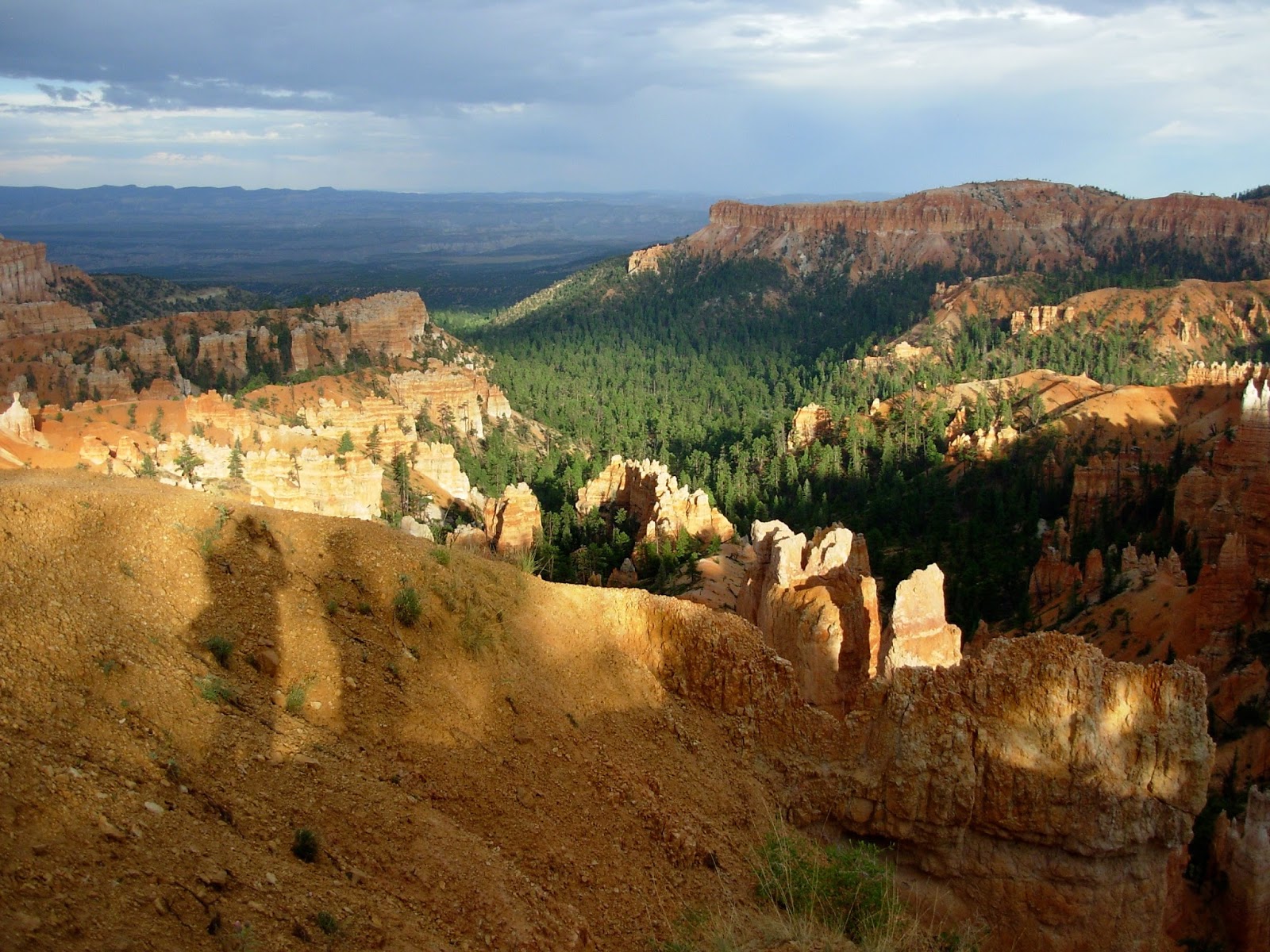
Along the way, we enjoyed pleasant company and conversation, stopped twice for snacks and stretches, and still arrived at Bryce well enough in advance to take in the view along the canyon's rim. The sky remained mostly overcast, but the setting sun easily found holes substantial enough to blaze through across the geological splendor arrayed before us.


And even in the shade it was easy to marvel at the range of color that seemed to melt over the layered topography like spilled paint...an inspiration for Messiaen's synaesthesia? 


At one point, I noticed our shadows projected onto a ledge in the foreground and snapped this picture...one of my favorite of the trip. A good friend is a wonderful thing...and one who enables experiences like this is even better. 


From my sketchbook journal:

From the pleasant ways in which time flies though beautiful country and easy friendship, I find myself at the canyon rim watching the last golden rays of a cloudy afternoon dance across the piqued landscape. A game of perspective. It spotlights some distant chorus of color...dims...and radiates again in fluid counterpoint. It steps back now to cast an audience in profile: a pair together in trusted solitude, foundations mingled atop ruddy talus slopes that float over a depth of reaching hoodoos. Just enough of what is right, and honest, and innocent, and sustaining, collides in that moment to awaken a prayer of gratitude and quench the fevered longing that has of late been my habit of being. I say nothing of this to my companion, but hope some equal measure has filled him also. 
Parallels stand. Look. Breathe. And continue walking. 

Good clean Bryce Canyon mud!

The stars didn't ever make it out that evening...at least not above the Park. Patrick's presentation was as entertaining and inspiring as I remember. Stories of exploration and discovery held the audience in rapt attention. But the star party was cancelled.

Along the return trip, somewhere south of Nephi, I looked up through the car window to discover a sky awash with stars...the Milky Way's familiar clouds eagerly gleaming through a gaping patch of clear.

I hoped to return soon...

July 19, 2013

Utah Visit, July 2013, #4: White Pine Lake

Early on in the hike up to White Pine Lake, a hazy Salt Lake Valley, rimmed on its western edge by the Oquirrh Mountains, becomes visible above Little Cottonwood's gaping granite mouth. It's a great place to stop for a breath of clean, pine-spiced, mountain air.

My had dad picked me up earlier that morning in order to get a good shady start up the trail before the sun crested the upper ridges. We took things slow. I'd been exercising regularly in preparation, but knew the altitude (about 10,000 feet at the lake) would likely cramp whatever small advantage I may have gained, and anyway, we were not hiking for speed, but for the enjoyment of being outside together in such a glorious environment. In the first few hundred feet we'd passed through a stand of young aspens: regrowth after an avalanche tore down the slopes years before, leaving behind a silent river of fallen trees and intimidating boulders. Little ground squirrels fearlessly darted across our path, while deer and moose who'd passed by earlier left tell-tale prints for us to admire in the wet black earth.

Technically, White Pine, one of three alpine-lake ascents that branch out from a single trailhead, poses only minor difficulty (at least for those with some level of fitness), but it meanders through an exquisite variety of mountain environments...from dark stands of pine...


...to rolling flowered meadows...


...to stark slopes of sheer rock and fallen boulders that remain frosted with patches of snow well into the summer.


 It is well worth the trip for seasoned mountaineers and weekend trekkers alike. If at all possible, I recommend going early on a Monday morning, as we did. The trailhead parking lot--filled to overflowing on most weekends and weekday afternoons--was virtually empty when we arrived, and until the last few minutes of our descent we saw only 4 other hikers. Blissful...and uncommon...solitude!

The last mile or so of the trail--though it also happens to be the steepest and the most exposed to the punishing UV of high-altitude sunlight--is definitely my favorite. It criss-crosses a vast talus slope and offers ever-broadening views of the peaks that surround the lake, as well as the colorfully-layered slopes of Little Cottonwood's northern rim.


For a sense of scale, see if you can spot the two hikers in the photo below...they're walking on ahead of us just right of center.


Vegetation in the area is sparse, but if you keep your eyes peeled, colorful surprises are waiting to be found...hidden gardens thriving in the shade of massive granite boulders.


We were both huffing and puffing over that last bit of trail. My muscles felt fine, but my lungs were working in overdrive. It's shocking how much more exertion is required approaching 10,000 feet...at least for one not acclimated to thin air. We stopped every 50 feet or so to catch a breath and look back over the stunning vista...one advantage to a somewhat limited fitness level, I suppose.

The trail reaches a high point on the slope, and then finally leads back down to the lake. That first glimpse of sapphire and green against a distant wall of jagged red peaks really takes your breath away...if you have any left by that point that is!


The view opposite the lake along the trail's final descent

We unpacked some trail mix and settled in atop perfect granite "picnic tables" for a light lunch by the lakeshore. White Pine, which is dammed on its northern edge as part of the valley's watershed, was as full as I've ever seen it. 


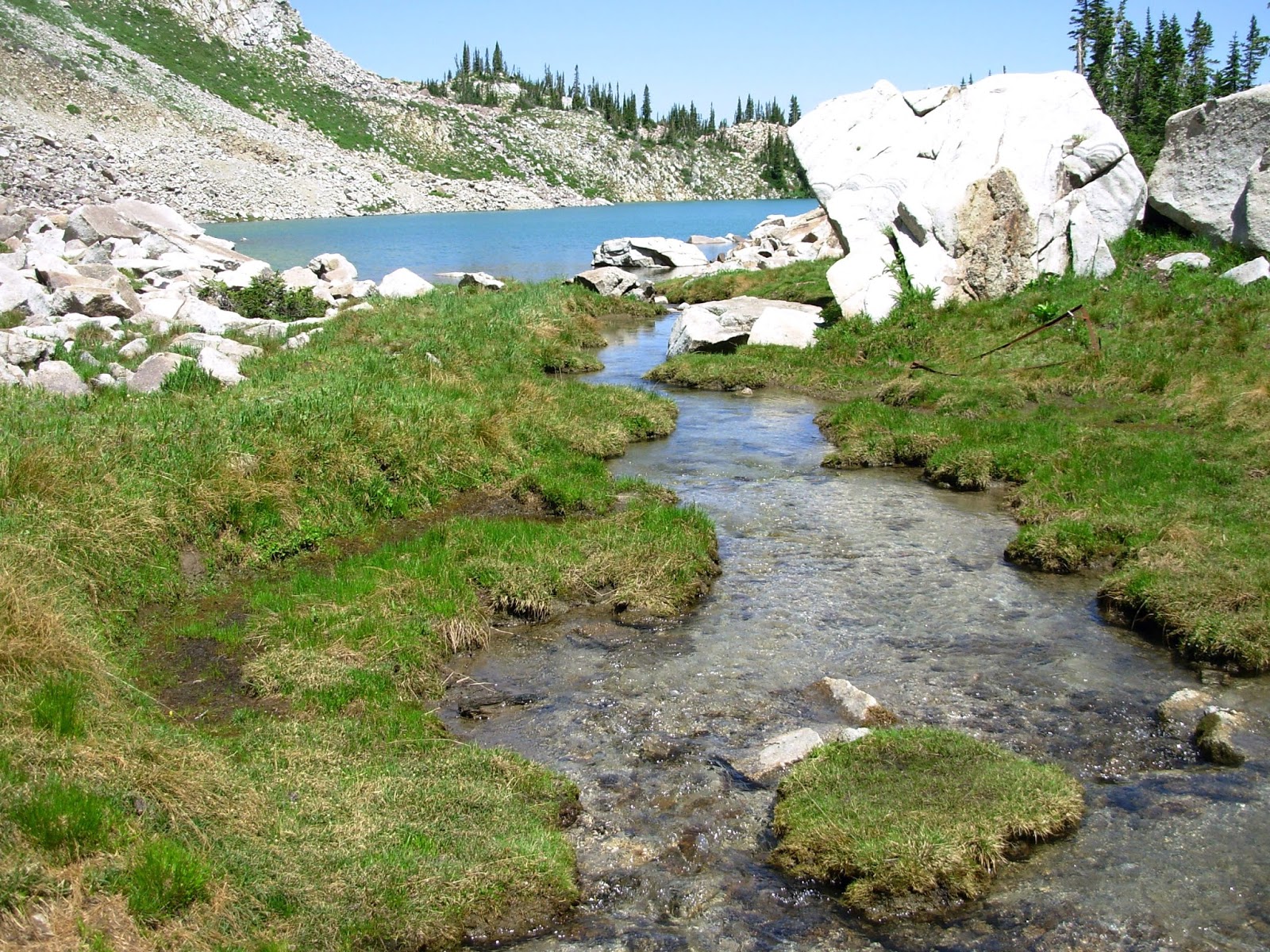
It is fed by at least one little mountain stream that babbles down from the slopes above...likely picking up a  bit of volume from hidden springs here and there along the way.


I was surprised by just how green everything was...I remembered the cloudburst I'd encountered the previous afternoon...looks like it's been a good wet year so far.


Earlier that morning I'd decided to leave my sketchbook behind, thinking we probably wouldn't stay long enough for me to put it to good use, but as I scanned the almost faerie-land-ish ambiance of the country around me, I regretted that decision.


It turns out we had plenty of time to linger. Dad wandered a bit, and then laid down for a brief nap. I found a perch above the shallow stream and watched patterns of light bubble and dance in the crystal water.


I remembered all the times I'd come up here to escape the stress and sometimes loneliness of day-to-day hustle and bustle. Somehow, those pressures and desires could never quite follow me up into these quiet mountain havens. Thus unencumbered, I was left to sense purely, and to dream wildly. It's naive to assume that dangers don't exist up here...that everything's just simple and carefree...or that the worry and emptiness won't catch up again as you head back into "the real world." But I treasure these brief retreats of spirit and imagination all the same...and opportunities to find them are plentiful in Utah.

"Utah is the state by which I came into the West: the place that as an artist was best for me...I wanted to find a land, a place, large enough to hold the feelings I held about the world, about this life we've been given. I wanted to explore what was possible, not just probable. I wanted more space in both the imagination and beneath my feet. And Utah's red wilderness and its forests had, and still have for me, the beautiful density of reality I was seeking: a density and grounding that in turn allowed my imagination to wander."  

   --Rick Bass, excerpted from his essay in Testimony (see recommended books at right)

White Rocky-Mountain Columbine

Eventually it was time to head home. We wandered down the mountain, speaking minimally, stopping only occasionally to admire a chance miracle of color...