May 23, 2014

Shine and Rain


Wednesday May 21

Went on a ranger led rim walk today. Ranger William gave a very windy walk through the ages beginning 35 million years ago at Sunset Point and ending at Sunrise Point in the present day. Learned that there are sites in the park that show evidence of ancient Native American history—petroglyphs as well as areas where flint was chipped down into tools. Though at least the petroglyphs were once advertised to tourists, they are now kept secret due to past instances of vandalism. How embarrassing for humanity that we can not even be trusted to respectfully enjoy these historical treasures.

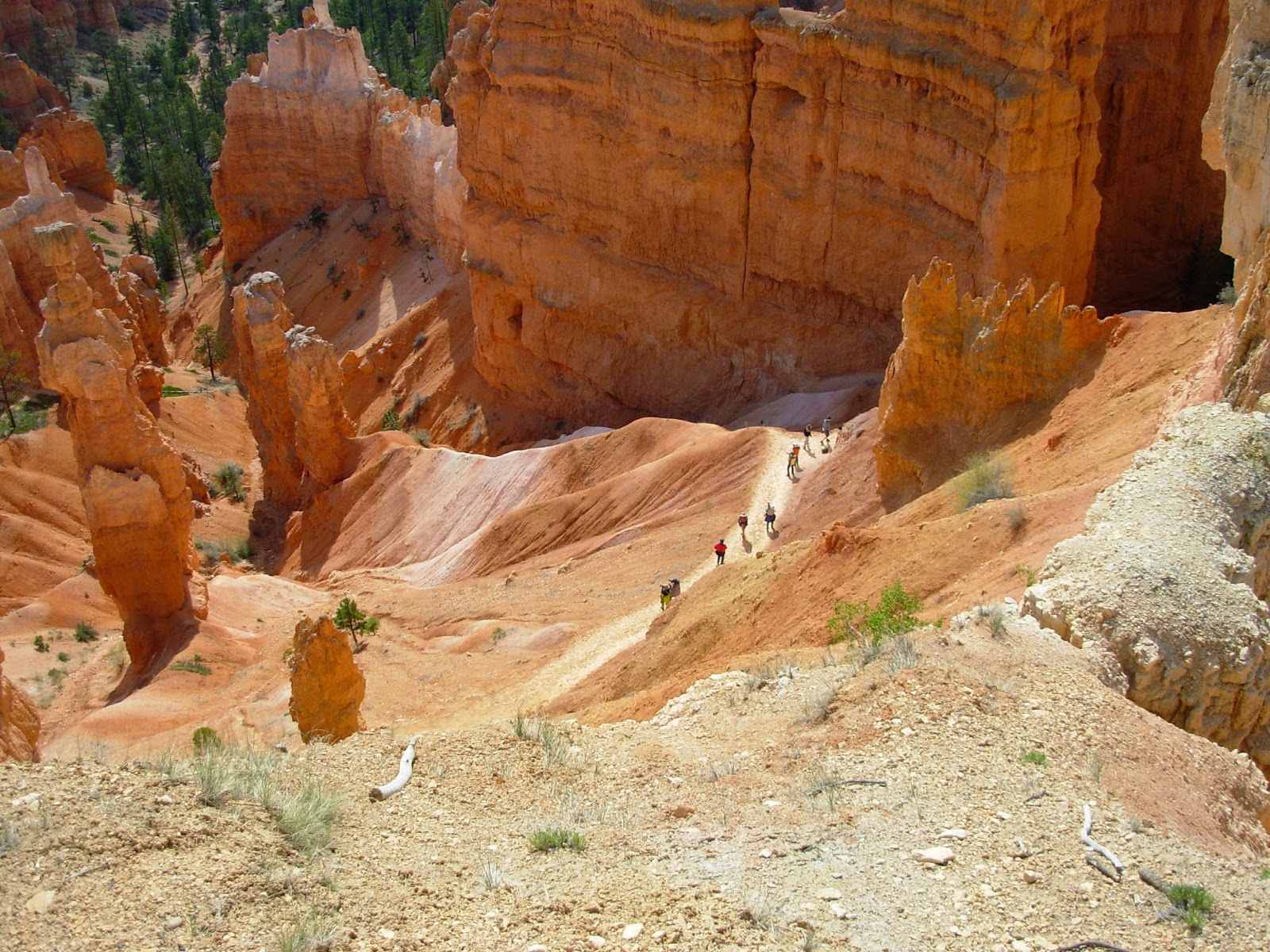
Also learned something new about Ebenezer Bryce. He was a Scottish shipwright who converted to Mormonism and came to “Zion” ready to carry the gospel wherever church leaders directed. Upon arriving in this area, he founded what is now the small town of Tropic and set up shop as a woodworker. Beyond being a bewildering wonderland of rock, “Bryce's Canyon” proved a particularly good spot for harvesting timber. The great Douglass Firs that grow among the hoodoos are straight and tall and devoid of branches until their very upper reaches climb above the towering rocks and into the sunlight. This means their trunks are knot free and of exceptional quality for building. Unfortunately for us, this also means that most of these strong and enterprising old-growth trees are now gone from the hoodoos. One of the most iconic and photographed places in the park—the Wall Street section of the Navajo Loop Trail (currently closed for rock-fall removal)—is one place where such trees can still be found. I'm hoping it will be reopened again before the end of my term here so I can share some photos.

At the end of the hike I saw my first Clark's Nutcracker: the legendary bird responsible for caching seeds way out on precipitous ledges and fins—places that trees are otherwise unlikely to grow—and the reason I'm able to take photos like these.


Thursday May 22

What a great day for solar viewing! Unlike last time, we had NO clouds getting in the way, and with Memorial Day weekend revving up, there was a decent flow of visitors. Radar and Kara set up the Park's Coronado and I brought my Dob along for its first public appearance outfitted with a new Seymour Solar off-axis filter.


Seymour Solar is a family owned solar filter company based in Escalante—only about 40 minutes from Bryce—so on my way down last week I swung by and just picked up the filter directly from them. Saved me on shipping, I got to meet the very friendly people who built it, and the drive was beautiful...a win, win, win.

The filter is coated glass and shows the sun in white light reduced in brightness by about a million times—SPF 1,000, 000...no sunburns here! Seen through it, the sun appears as a beautiful orange/yellow disk, and I've been able to see quite a lot of detail, especially in the sunspots. Today there were four main spots grouped together in the area of the sun I chose to focus on. They looked small compared to the whole solar disk, but might have been about the size of Earth. A few tiny black pinpricks were also scattered nearby. As seen in the NASA image above right, around the sunspot's coal black centers (umbra) were lighter more grayish areas (penumbra) streaked with fine feathery detail. The whole complex of spots was embedded within faint Plages (French for “beach”)—like black islands surrounded by a lake of pale fire. Seeing the slight color difference of the Plages took some practice, but once seen, they gave the sunscape a truly fascinating dimension and texture. I feel like I also caught hints of boiling Granulation...just my imagination?

Between the two scopes—mine in visual light showing off the “Photosphere,” (sphere of light) and the Coronado displaying the “Cromosphere” (sphere of color)—we were able to show people a whole variety of features. The Chromosphere is a dimmer layer of the sun's atmosphere that is normally lost in the glare of the much brighter Photosphere. Like trying to see a candle held up against a spotlight, features like Prominences and Filaments are only made visible when all but a specific wavelength of red light—Hydrogen Alpha—is filtered out. Truthfully, the sun in H-Alpha is usually more interesting to look at than visual light. Prominences—great spires and loops of plasma—erupt off the sun's surface, and dark red filaments—Prominences seen from above—snake across the boiling red “landscape.” Comparing the two views offers an opportunity to tell people about these layers, and give them a striking first-hand experience of how filters are used in astronomy.


**Breaking News from the Visitor Center Main Information Desk: WALL STREET IS NOW OPEN!!! Stay tuned for photos.

Storms moved in late in the afternoon so our nighttime stargazing was clouded out. Ever the optimists, we still started setting up. My scope is on the left, dwarfed by "Thor" on the right.


After the official cancellation call was made, we came back to the astronomy house for “game night.” It turns out that all three of us brought a variety of board games. Last night we played Radar's “Quirkle,” a colorful combination of Scrabble and Dominoes. Tonight's choice was Kara's “Key to the Kingdom.” I'm looking forward to another night where we bring out “Eight Minute Empire.” I'm so used to playing that with only two players—Rob and I—it will be fun to see how the gameplay changes with more people.

May 21, 2014

A helluva place to lose a cow


Sunday May 18

Day off. Got caught up on email, blog, FB...all the busywork associated with money and communications. Won't get to check for responses for another day.

Finished up just in time to go watch Cheryl give a geology presentation at Sunset Point. Wind was strong and sent laminated paper visual aids flying everywhere. Fortunately a quick moving spectator gathered them all up before any ended up in the bottom of the Canyon...or no...as I now know, Bryce is not a Canyon...the park could more correctly be called Bryce Amphitheater. Canyons, like the Grand, Zion, and my hometown Little Cottonwood are deep gorges carved out by rivers or glaciers. Bryce is a high plateau whose defining features have instead been carved by seasonal effects of freezing and thawing—so technically not a Canyon. The canyon designation was just a nickname given by early Mormon settlers who called this maze of hoodoos that existed behind Ebenezer Bryce's land “Bryce's Canyon.” “A hell of a place to lose a cow.” according to Ebenezer.

The sediment that makes up Bryce's layers was laid down by millions of years of sea, desert, and lake. Uplift raised the plateau to its present height. As periodic rains gush down its walls and uncover harder layers of rock, those newly exposed layers are sculpted into fins by a process known as frost wedging. Water seeps into cracks, freezes and expands. Pieces of rock are pushed away from their parent body and fall into the depths. Fins, windows, arches, and finally hoodoos are left behind...well, that, or the greedy Legend People were turned to stone by Coyote for their selfish avarice. A beautiful morality tale told by ancient tribes of native Americans who lived in this area.

I got another roommate today. Kara, an intern for the Geological Society of America, arrived this afternoon. Remembering how lost I felt when I first got here, I resolved to share everything I know about how the program runs, and where stuff is. Though there are still a few gaps for me, at least she knows the layout of the VC, she's got most of her uniform (minus the hat), and now knows how to read the schedule. 

As this is her first visit to Bryce, and indeed the southwest in general, we also toured the lower Amphitheaters, and hiked to Mossy Cave, a short trail accessed outside the Park's main entrance. I just realized that I didn't take any pictures of the cave. Oops. I did catch some views of the lovely stream running along the trail...


A waterfall...


A nice row of windows...


And a red rock formation I thought resembled a barking dog...


 After dinner and a couple games of “Eight Minute Empire: Legends,” we drove out to the rim at Fairyland Point to (on advice from our supervisor Geoff, who will be arriving in June) weep over Bryce Canyon's unbelievable night sky. My first great night out as well, we were both giddily stunned by the sheer numbers of stars. As it is spring, the main swath of Milky Way—from Cygnus to Sagittarius—that most people adore for the grand north to south arch it makes in summer, was just starting to rise in the east. A little lost in the thicker atmosphere on the horizon, we only caught hints of the glory that is soon to come. I pointed out a few prominent constellations. Though with so many stars it was “hard to see the trees for the forest” so to speak. Not a problem I'm likely to complain about too much! We also caught some beautiful binocular views of M4 and M13—both globular clusters. 

All in all a satisfyingly full day.

Monday May 19

Found a copy of “Track of the Cat,” the first Anna Pigeon novel, among a collection of donated books in the laundry room this morning. Before leaving for Bryce two people recommended that I check out this series. Each novel is set in a different national park and the protagonist, Ranger Anna Pigeon, encounters mysteries—in this first book, a supposed mountain lion kill in the Guadalupe Mountains of Texas which Anna believes is actually a murder. I've never read mysteries in the past, but have been enjoying this one so far. Perhaps a nice stand-in for the mystery tv shows Rob and I have gotten into recently: Morse, Lewis, Luther, Sherlock...

Checked in with Jan Stock and Kevin Poe at the VC this morning. Got a stack of helpful reference books about Bryce Canyon to increase our knowledge of the park, its history, geology, flora, and fauna. Instead of doing our regular solar observing tomorrow, we've been asked to walk the main trails in uniform making visitor contacts when possible. ”Roving” I guess it's called.

Kara and I hiked the entire rim portion of the Fairyland Loop trail this afternoon. Only 2.7 miles one way (5.4 for us since we went out and back), but with a lot of up and down, so we both got pretty tired. The sun feels VERY close here. Just a little too easy to get burnt. The high altitude that contributes so nicely to a pristine night sky makes extra vigilance necessary during the day. Water. Sunscreen. Rest. The environment is beautiful though. At this point I feel I can easily recognize some of the most common members. Ubiquitous Manzanita, Utah Juniper, Ponderosa Pine, Limber Pine, Uinta Chipmunk, Stellar's Jay. We also saw lizards, a vulture, raven, and some kind of amazing ant that was covered in bright red fur. I think I've heard of something called a velvet ant?

In the evening, not too long after the sun had set, I drove a little ways south in the park. Stopped along the way to check out a couple viewpoints and trailheads. Coming back in the deep twilight, expansive meadows along the road were filled with Pronghorn. I could see their gray forms darting around in playful circles. A game of chase? Clocked at 55 mph, these animals are the fastest in the world next to cheetahs. One was perched right at the edge of the road standing tall and still in my headlights as I inched by. I said silent prayers that he wouldn't decide to dart in front of me at the last minute. Hitting a Pronghorn would NOT be the best way to star off the season.

Tuesday May 20

A hummingbird at my window this morning!

Roving the Queen's/Navajo Loop trail proved a delightful four hours of work. From the VC shuttle stop to the trailhead then down among the hoodoos and back, we encountered 88 people. Hailing from all over the world, some wanted directions, or asked advice on what else they should do later in the day, some had questions about the local geology or wildlife (thank goodness for our handy field guide), some were curious about our position as volunteers—where we'd come from and how we'd gotten involved—and some just wanted assistance with photos—sometimes requesting photos of us two “charming Ranger-ettes.” 

And thanks to a gusty wind at my back for adding 30 lbs around my mid-section. 


Our mini conversations often allowed for brief mentions of Bryce's superlative night sky, and some interesting things that may be observed there...a chance to advertize the astronomy programs taking place later that evening. We climbed up to the rim along the steep switchbacks of Navajo, and finished the 3 mile trail dusty, a little out of breath, and really needing a bathroom! But who can complain about such things with a job like this?


After a brief lunch, we headed back in to the VC for project time and, in my case, front desk duty.

A sad bit of news. There was a heart attack today—the man passed away. Bryce averages less than one death per year, but heart attack is the leading cause. It's followed by falling off cliffs, lightning, and vehicle accidents. Unpleasant statistics that should remind us all to behave more safely—wear good footwear, head indoors in a storm, drive the speed limit...oh, and DON'T drive your motorcycle out onto Inspiration Point, like some wholly OBNOXIOUS risk-taker did today. I heard that a few onlookers captured photos. Hopefully the NPS will be able to extract his plate # and issue a citation.

A partly cloudy and windy day gave way to a spectacular night of observing! Best night so far in my opinion. As the night deepened we treated loooooong lines of spectators to views of the planets, star clusters (I claimed my old favorite the “Beehive”), planetary nebula (the Ring), and at least 3 galaxies. I first went to M51: the “Whilrpool.” The large member of this pair of interacting galaxies showed off some striking spiral structure—something I'd NEVER been able to see in a galaxy until tonight! I was blown away! Couldn't stop exclaiming that “Bryce is AWESOME!” I also helped the other operators get the “Sombrero” , M104, into Thor's aview. They'd been struggling to find it for a few minutes, but as M104 has been a recent favorite of mine, I was able to locate it in seconds. “Wanna know how to find M104?” I asked, planning to show them “Jaws,” the helpful little asterism that points right to the galaxy like an arrow. “Just call Kelly!” came the response before I could say anything. My little head swelled just a bit too much with that one.

Don't worry. I was sufficiently humbled later when I tried going back to M51and was totally unable to relocate it. How is that even possible?! After being so easy the first time, I discovered when I got home that I was aiming just a little off course. Ugh! How embarrassing. With the preponderance of computerized go-to scopes, I've remained an advocate of learning the sky and navigating to objects manually. I've always found it quicker and easier than trying to get everything aligned and waiting for a slow motor to slew to the vicinity of an object that you later have to locate precisely yourself anyway. Easier, that is, until you have a major brain fart, like I did in this case. Sigh. Better luck next time. I'm gonna get this one down so it's second nature.

May 18, 2014

Have a Bryce Day...or three


For those of you who don't know, I'm spending two months at Bryce Canyon National Park as an Astronomy Volunteer. Since my personal internet time here will likely remain fairly limited, I've been trying to keep a sort of daily "Journal" from which I'll share excerpts here and there. Here are the first three days. 

Thurs May 15, 2014

Arrived at Bryce this afternoon. Checked into the Astronomy House, and got situated in time to help out at the observing session tonight. Just past full moon, and a sky laced with hazy clouds. Warm temps. Still, views of M13 were decent, and the planets of course were gorgeous. The other guys were mostly focusing on planets, so I decided to go back to some old bright standards just to offer some diversity. Mizar & Alcor, the Stargate (Jaws and the Sombrero briefly), and, as I already said, M13. We had about 150 people show up. It was a madhouse! And all of us packed into a tiny parking space in the front of the visitor center—I guess we move around back later in the season.

My assignment for tomorrow: get out and enjoy (learn) the park. What torture! If I'm going to be manning the front desk at the visitor center, I'd better know my way around a little. I'll be doing all the hikes I can, obviously enjoying myself, but with an eye toward “what would be important for a visitor to know about this.” 

Friday May 16, 2014

Could REALLY feel the altitude today. Hiked the Navajo/Queen's Garden Loop and had to take it slow. That's ok though. This is a good place to go slowly. Never a shortage of things to see...


Once again a little disgusted that I was one of those typical tourists pulling out my camera every 5 minutes...but at least I wasn't carting around a tripod too. 


The air felt really dry, the sun felt really hot...and close...and my lungs couldn't quite keep up with things. Whereas I had originally hoped for some harder hiking later in the day, I resolved to listen to my body and take things easy. I'll be here for two months after all. Plenty of time to adapt to 8000 - 9000+ feet above sea level. Lunch sure tasted good after all that: lentil soup with vegetable stir fry. The house smelled fantastic. 

Went to Yovimpa Point on a cloudy afternoon. Didn't look as pristine as I remember it being. Could see roads, buildings in a couple places. Are these new? Or did I just miss them before? Bristlecone pines are beautiful...even the dead ones. 


Couldn't quite figure out if I was identifying them properly...bristlecone, limber pines, douglas fir, ponderosa pine...you'd think I'd have an easier time telling them apart. Keep thinking I should get a field guide. Walked the rim from Bryce Point to Sunset Point. Gorgeous. Vertigo inducing. 


It occurred to me that Bryce Canyon is a display of prolonged decay. Collapse. Entropy. I've wondered in the past how the beautiful places we love will appear in however many billion years, when the sun has swelled to a Red Giant and Earthlings have either fled or perished. We work so hard (some of us) to preserve these places (as we should), but they are not eternal. As godly a landscape as Bryce is—as iconic—as still—as unique and seemingly irreplaceable—the edge of the canyon is wearing away at between 1 and 4 feet per century. In no time at all “geologically speaking” it will all have eroded away to dust. Swept out to the Pacific within the periodic currents of desert streams. What will it be like to watch those last painted spires disintegrate? Will intelligent beings eons hence even know that such a canyon even existed?


On the docket tomorrow: 
Solar Observing
Visitor Center duty
Nighttime Observing
(hopefully...finally) getting my “uniform”

Saturday May 17, 2014

Yup...finally got my uniform today. It consists of a brown button-up pocketed shirt, name badge, warm jacket, and wide-brimmed mesh hat—each of which display a “National Park Service Volunteer” patch. It's hard not to feel the urge to stand a little taller while wearing it. 


Began the day with a short hike along the Fairyland Rim trail. Less busy than the main viewpoints between Bryce and Sunrise Points, and a little more up-and-down in elevation. Some enormous spires and hoodoos right up against the edge of the trail. Photographed a baby Limber Pine growing atop a rocky windowed wall. 


It's like the trees here have an actual dare-devil personality—perching atop the highest and most exposed ledges—hurling themselves over the edges of things—ready to take flight. Really it's often that they take root on firm ground only to find that in a few decades the earth has begun to erode away beneath them. All that anchors them is a strong branching root system clinging ever further into whatever foundation may still exist nearby. 


Solar observing began the day. I got a brief how-to on the Coronado. (I hope I can remember it for this coming Tuesday!) Then Radar and I sat out in front of the VC hoping to draw in a few curious spectators. Beautiful prominences, filaments, and granulation readily visible. Possibly some small sun spots. Also, finding the sun in a telescope is a lot harder than it looks. My most embarrassing moments of the day consisted of me fumbling to relocate the sun while Radar sat off to the side a little baffled at my struggles. Ugh! I'm sure I will get better next time. 

Worked for a few hours at the VC front desk. Lots of standing. Answering questions. “We just got here, so what do you think we should do?” “Well, do you like to hike? Mind taking the shuttle? Have a car? Want to see a Ranger program?” I'm still learning the ropes here, but hopefully I was helpful to at least a few of the many dozens of visitors who approached me. 

A “clear” evening forecast proved wholly inaccurate. Our sky was socked in with clouds until Mars, then Jupiter, a small smattering of bright stars, and then Saturn started poking through the haze. I guess a bunch of Bryce Canyon's 60 cloudy nights per year are taking their turn this week. Views were lukewarm. But the few visitors that showed up were enthusiastic and enjoyed telescopic views without the clamor of excessive lines. I operated "Thor." A huge Dobsonian requiring a ladder to reach the eyepiece. Man I love light buckets!

My next 2 days are off. More enjoying the park for me!

January 29, 2014

"Can You Walk on the Rings of Saturn?"


There are no limits on the creativity of questions that a curious child can come up with:

“Why is Earth the only planet with life?”
“What would happen if the sun disappeared?”
“If you were to fly a spacecraft to Neptune and go through the gas, would the fire from the rockets ignite the planet?”
“How do we know that Pluto is icy if we've never been there?”
“What happens when you die in space?”

These are just a few of the many questions and comments I encountered last month during presentations about “Seeing the Solar System” that I gave to six 5th grade classes at Sailorway Middle School in Vermilion, Ohio.

Some of the questions allowed me to go into more detail on the subject at hand:

“Why is Pluto not a planet?”

Some were quirky, but oddly perceptive:

“Herschel's telescope looks like a guillotine, but without the blade.”

Model of the telescope William Herschel's used to discover Uranus. From the Herschel Museum in Bath, UK.

“Galileo's fuzzy view of Saturn looks like a pig's nose.”


Some of them allowed me to discuss related topics:

“Why does the Earth go in a circle around the sun?”
“How do you measure the speed of light?”
“What would happen if you fell into a black hole?”

But my favorite comments and questions allowed me--a representative of the Black River Astronomical Society, and the supposed “expert” in the room--to see the things I was talking about in a whole new light. When I showed Cassini's picture of Saturn viewed from its nighttime side, one student said:

“It's like if we had Saturn as a moon on Earth, and it was making a solar eclipse.”

image credit: NASA/JPL-Caltech/SSI

And after showing pictures of Mars' surface taken by Curiosity Rover that were reminiscent of the Arizona desert, a shy little girl came up and suggested to me that:

“Maybe a piece of Mars came off and formed part of planet Earth?”

image credit: NASA/JPL-Caltech/MSSS

Though her hypothesis was incorrect, the insight behind it led to a discussion about how similar elements and processes formed features on both Mars and Earth.

My talk's focus was that astronomy is a science based on observation, and that there are different things we can learn about our “local neighborhood” based on what we see through our eyes, and various technologies like telescopes, spacecraft, rovers, and even scientific illustration. My goal was to encourage students to visualize the places and ideas they were learning about in class, and to equip them with various means to actually observe some of these objects for themselves. I brought along two telescopes as visual aids—a borrowed BRAS Dobsonian (“That looks like a cannon!”), and a small refractor—and allowed the kids to take turns looking at the mirrors and through the finder scopes (“Whoa, the dots on the ceiling are really close!”). 

The sessions were great fun. There is nothing quite like standing in front of a young audience when they see something wonderful for the first time—hearing that excited intake of breath when the “lightbulb” goes off, or watching a forest of hands erupt when a tricky question yields a surprising answer. And when faced with their awesomely daunting array of questions ranging from “Is a supernova like the Big Bang,” to “Can you walk on the rings of Saturn,” I am encouraged by the engagement and interest such queries display. In a time when media warns of students falling behind in math, science, reading, and creative arts, and when the glitz of commercialism threatens to stifle participation with the natural world, organizations like the Black River Astronomical Society offer a valuable means for children of all ages to get involved with a creative and stimulating science as part of a welcoming local community. I am grateful to play some small part in that mission. Even beyond the enjoyment I get from learning the sky—from acquainting myself with its patterns and cycles, or resolving beautiful objects of unimaginable scale—I've discovered that the driving motivation behind my interest in astronomy is sharing and experiencing it with others.


I'd like to send a big “Thank You!” to Mrs. Julie Zelina at Sailorway Middle School for allowing me, on behalf of BRAS, to participate in her classroom...and an even bigger “Thank You!” to all of her students and their fascinating questions!


January 24, 2014

Nostalgia

There's a beautiful clear sky this morning...waning crescent moon in between fast fading "stars" Saturn and Mars. It'll be a nice sunrise. Too bad the wind chill is -19.

It makes me miss Chicago. On a day like today I'd already have my layers on and would be speed walking down to the shore of Lake Michigan for a daily-sunrise photo session. 

It might've looked something like this...


December 19, 2013

7 great reasons for shoveling !#*%

Every Wednesday and Thursday I hurry out of bed and head over to the Oasis Animal Shelter where I spend the morning helping another volunteer clean kennels. My part of the job consists of shoveling big piles of poop out from the outdoor portions of each dog's run, while my coworker disinfects and hoses down the insides, sets down food, and fills each pail with fresh water. We coordinate our movements while allowing each dog some good quality run-around-the-yard, play-with-the-ball, sniff-around-the-fence, and bark-at-the-cats time (don't worry, the cats are outside the fence...and we put food and water out for them too).

This job has equipped me with a nuanced understanding of a range of canine excretions and how best to deal with them. Whisking up the really soft stuff on a humid July day requires a whole different set of techniques, for instance, than does scraping up frozen piles in sub-zero wind chill (the latter often helped along by a good kick from a heavy boot). All the "material" I remove from the pens is piled into a big plastic poop bucket and later washed down an outdoor drain in a soupy swirl of pungent goo. No bones about it: it's all pretty repulsive. When I start scooping I stop breathing through my nose, and generally don't start again until I'm out walking dogs. It's amazing the disgusting things you can handle if you eliminate their smell!

Despite what you might think from this description, the Oasis dogs are really well cared for. Their pens, which have space to move both inside and out, are cleaned three times daily. They do not go hungry or thirsty, they are warm in the winter, and music is left on for them when we leave. Veterinary care is given when needed. And unless the weather is REALLY bad, in addition to yard time, they get walked at least twice a week. Their lives would improve a lot with adoption, but until then they make do just fine.

Well that is all fine and good, but what really compels ME to return every week just to shovel more of their stinking !#*% for no pay? Ha!

Today I found 7 reasons:

#1. Chloe...


Quiet, intelligent, patient, disciplined, and great on a walk. When Chloe jumps up to give you loves, you know she really means it.


#2. Paddy.


A dedicated and exuberant player, she LOVES diving through the powdery snow.


#3. Buddy.


A booming voice and tough exterior belie a heart tender as a puppy's. Buddy is the perfect name for this big guy.


#4. Herbie.


Total sucker for a good belly rub...especially when it means he can also roll around in the snow!

#5. Ronnie.


A bit intense on a lead...especially when the ground is laced with deer track! You can always tell this girl means business.


#6. Sassy.


Scruffy little ball of fluff and affection...what's not to love? 

#7. Blade.

A big heart in a little body. When this feisty little chihuahua finally warmed up to me...transforming in weeks from a nervous introvert snarling in the corner, to my most eager and devoted Oasis friend...I was a goner. I ADORE this little guy!


There are lots more dogs at Oasis, and every single one provides another reason for me to put up with the early alarm, and the joyful need to scoop little piles of steaming !#*% for a couple of blessed mornings each week.

November 8, 2013

A Strange Courage

Working with color is a challenge for me--one I confronted head on in my latest drawing...


El Hombre

It's a strange courage 
you give me ancient star:
Shine alone in the sunrise
toward which you lend no part!  

    ~William Carlos Williams 
   from his collection, "Al Que Quiere!"

    
I stumbled upon this poem while idly browsing the web a few months ago, and liked it enough to bookmark the page for later reference. Upon reading it again late last week, an image began to take shape in my mind. Things seemed easy enough starting from my comfortable home-base of black and white, but I realized early on that the piece would eventually require a more ambitious exploration of bright color.

As a kid I remember hearing somewhere--don't know where at this point--that in order to master color, an artist first needed to master black and white. It was a reassuring thought as I delved even deeper into my emerging preference for stark contrast, crisp lines, and austere form..."I'll get really good at black and white and then...just imagine the possibilities!" Maybe I got too comfortable. These days, if I use color at all, it's generally one shade, maybe two, and used without much nuance, blend, or shading--bold areas of color that mirror the distinction of their equally unambiguous frame.

 For El Hombre I envisioned a sort of middle road. I knew I needed a lot of color, but wanted to avoid ruining things with a sad attempt at shading or gradation. I just don't have that skill at the moment. I resolved instead to select a limited palette and apply it in big blocks--more in the style of mosaic or stained glass than a pencil drawing.

I'm more or less satisfied with the result...though I can't help but cringe just a little at its brightness whenever I look at it. It's like I'm practicing really loud excerpts on my trumpet and just KNOW that the neighbors are about to pound the door down with threatening expletives.


October 13, 2013

Full Moon Glare

A few weeks ago I stepped out onto my front porch and watched the full moon shine out from behind bands of rolling clouds. Because of an optical effect caused by my glasses, long glaring beams seemed to radiate from the moon's face and spread out over the sky like a ghostly flower. Though the thick clouds proved impenetrable to the moon's reflected brilliance, their edges still shone with feathered silver. This image stuck in my mind, and provided the inspiration for my latest astronomical abstract...


Here are some "in-process" shots (please forgive the TERRIBLE quality of the photographs)...


And a slightly zoomed in view of the moon...


...and the signature I remembered to add later...only after I took the photos above...oops.


Finishing an artwork always leaves me with mixed feelings. On the one hand, it's nice to have something that feels more or less "complete." But on the other, now I've just got another blank canvas taunting me from the sidelines.

So what's next?