November 18, 2015

Canyonlands: Training Week


This week I finished up training for my new volunteer position at Canyonlands National Park (CANY), "Island in the Sky" district (ISKY). Now I come to work in uniform, greet and provide orientation for guests, cashier at the bookstore, rove trails, and prepare for the astronomy training I'm going to give over the next few weeks. The winter staff at CANY is a small, but very friendly bunch, and I feel I fit in pretty well so far. I've been keeping an occasional journal since I've been here and have posted some entries below along with a few pictures. Before I go any further let me just say that it feels almost impossible to photograph this landscape with the basic point-n'-shoot I've used for the past decade. The panoramic views are too immense, the distances too great, and the light contrast between the sky and the rock too pronounced. NONE of these photos come close to representing the reality of this place...you really have to come here yourself.


Tues, November 10, 2015

I drove up to the Island in the Sky under a chilly gray drizzle. Flat ranges of brush surrounded bulky red-rock tables and stretched toward curtains of cloud that hid the horizon on all sides. Somewhere beyond those clouds is a view I’m about to fall in love with, but until the weather breaks, it’s going to remain a mystery.

I checked in at the visitor center (VC), got keys to my house, and drove back up the road toward the little duplex that’ll be my home for the next few weeks. Turns out, it’s brand new, spacious, and beautifully appointed. Large windows look out over the mesa top, and I can’t wait for the clouds to clear so I can see what I’ll be waking up to every morning! Slushy snow fell as I unloaded my car, and about an inch had accumulated by the time I drove back down into Moab on my first grocery run.

Snow-flocked sage boughs, deep brick reds in the rock and soil, heavy clouds looming like a bruise on the sky—the land around me was heavy, intensely colored, and obscured by banks of drifting fog. On the way back up a couple hours later, the starless night was as black as a raven's wing, and driving snow, dazzling in my headlights, forced me to slow to a crawl. I’m anxious to see how morning will break.

Wed, November 11

I woke up to four inches of snow and a sky as clear as any I’d ever seen. I looked out as the sun was just peeking over the horizon—the last pinkish band of night sliding away in the west.


After checking in with Michael, my boss for the next couple months, I started my exploration. And how lucky that my first views of the park would be enhanced by a fresh snow!


Snow covers some things up, but reveals many others. As it clings to slopes between trickles of meltwater and hides away in shaded nooks, textures and shapes that might otherwise have eluded attention appear in high contrast.

The picture to the left was taken from the Schafer Trail overlook, near that popular road's precipitous (and now snowy) initial switchbacks. Later in the week, melting and refreezing turned the road into a mess of ice and mud that stranded one driver and necessitated a route closing. 


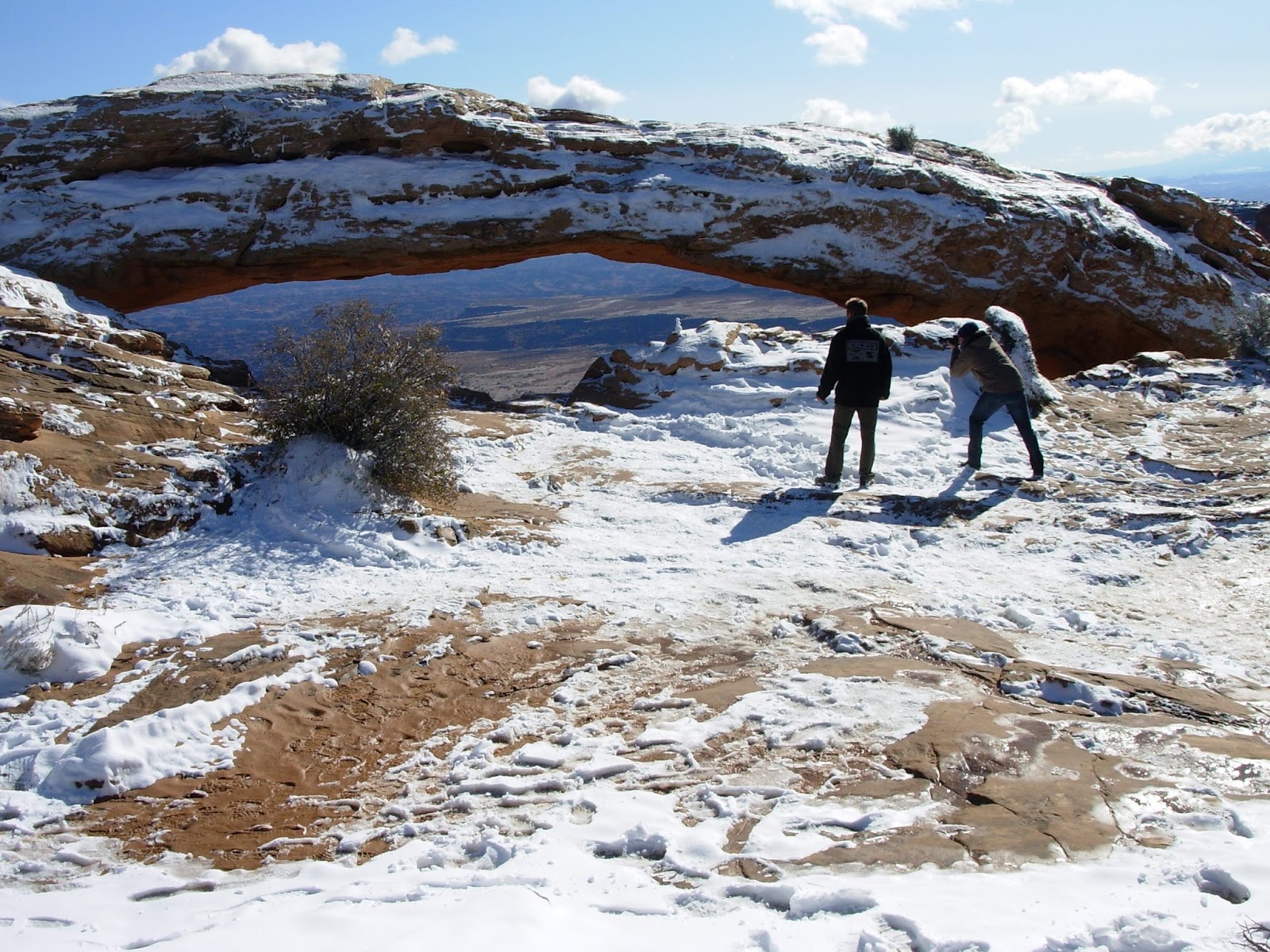
My first “famous” stop was Mesa Arch. The walk to this iconic feature was an easy 1/4 mile through slickrock and fanciful yucca gardens. An interpretive sign nearby says something to the effect of: “many people come to watch sunrise here, so be courteous and step out of the way so that everyone may have the opportunity to see and photograph this spectacular event.” I laughed to myself and wondered how often those instructions were actually followed, but then remembered a study I read earlier this summer that shows that most people, while basking in an area of natural grandeur, are actually more pleasant and courteous than normal. Maybe the suggestion works after all. I'll have to go early sometime and conduct my own observations. Even though it was later in the day, and we'd missed seeing the golden light of sunrise, those of us who arrived at Mesa together this morning still took turns capturing the view through the span. Sometimes it’s just as fun to watch other people observing as it is to observe the view myself.


Midday...

Grand View Point. What can I say about this overlook that won’t degrade into a litany of superlatives?


What can anyone say about an unguarded 1400-foot drop straight down from where they stand? Or about vertical red cliffs lording over endless miles of table-top sandstone that then drop another 1000 feet into a canyon of spires, and monuments and, somewhere, a river still carving it all away? You can imagine being at eye level with the Empire State Building—if they’d built it flat on the sandstone shelf below. You can imagine individual grains of sand being gently washed away by the drips and trickles of melting snow you hear all around you...


...just single grains, now and then...


...that over a span of time greater than can be humanly comprehended, eventually add up to the shapes carved into the landscape below. You can feel your feet tingle slightly with an itch to fly…and then step back from the edge a few more paces. But mostly, your brain, or my brain maybe, just gasps, “Whoa…” and then stops thinking.


Afternoon...

Upheval Dome: eroded salt dome? …or METEOR CRATER!? You can’t really tell from these photos, but this enigmatic feature is actually a circular bowl cut into the terrain. As a skeptic that would REALLY love it to be the site of an ancient impact, I somehow feel inclined to dismiss that option as the least plausible—just because it’s the explanation I want. Does anyone else do that too?

A few days after I wrote this, a friend sent me links to research that definitively identifies Upheval Dome as an impact site. Now I have to find out why we're still asked to focus on two competing theories, rather than highlighting the AWESOMENESS of the true conclusion!

The desert view can only get better when seen from the back of a whale—Whale Rock, that is.


I originally thought this would be my vantage for sunset, and played around with shadows and reflections for a while as I waited for the sun to fall behind the far western mountains.


But a nagging curiosity about the Green River Overlook eventually lured me down and back to my car. I’m glad it did.


There’s no possible way my camera could’ve captured the colors and dimension that actually existed in this scene. The sky was a bright translucent rainbow from orange to yellow to blue. The canyon’s first step, 1400 feet below, was a rich chocolate brown that gave way to frosted tan along the eroded lip of its second step: White Rim—an apt name. The first time I saw photos of it I incorrectly judged the bare rock to be snow covered. Even after the sun winked out behind the Henry Mountains, the White Rim sparkled with pools of melted snow still reflecting the pale blue sky above. On the opposite horizon, the Earth’s shadow appeared in intense rose, and then navy—the belt of Venus. And then I knew I’d be going out for stars later.


Thursday, November 12

Training week.

A chorus of coyotes is my alarm clock.


 My walk into work.


Work.


The view from my office (well...just a quick jog across the street from the VC).


I read, and read, and READ, and observe, and rove a new trail—learn how to follow cairns up steep slickrock a little bit better than I did the day before—and end up looking toward the La Sals at the top of Aztec Butte. There are Ancestral Puebloan granaries up there—hidden by ledges too low to kneel under.

My walk home from work.


Friday, November 13

Training week.

My good-morning coyote chorus begins around 5:30 am...yawn...

Read, tour the maintenance yard, read, do Jr. Ranger books and Explore Packs, READ, review passes and fee procedures—not that I can take them myself, but just so I know—and then READ som'more. What I got from my reading: the sequence of rock layers exposed in the park (let’s see if I can get this without cheating). Navajo Sandstone and the Kayenta Formation make up ISKY’s mesa caprock, Wingate Sandstone takes you down the first dramatic step, moderated by the sloping Chinle Formation, and then the Moenkopi—Chocolate cliffs!—then we hit the White Rim Sandstone Formation that caps the second major step down over the cliffs of Organ Rock—same stuff that supports the “Mittens” in Monument Valley. Below that, well, I’m a little fuzzy, but way at the bottom is the Paradox Formation—I love the name, it’s why I remember it. Ok. Checking my answers. Yup, got most of them. Below the Organ Rock Shale is Cedar Mesa Sandstone (best seen in the colorful spires of the Needle’s District…they don’t call them hoodoos…I wonder why?), then the Elephant Canyon Formation, Honaker Trail Formation, and THEN Paradox.

What’s more important than the names, though, is what they are and how they were formed: each layer a record of a particular environment that existed in this area hundreds of millions of years ago. Seashores, lakebeds, stream courses, sand dunes—the future Canyonlands grew up out of an extremely varied succession of landscapes. All of them cemented to rock, uplifted thousands of feet, and then scoured into a vast system of canyons by today’s rivers, the Green and Colorado.

Colorful lichens on sandstone: Murphy Point Trail
After lunch I got another exploration rove. Today’s destinations: Buck Canyon Overlook and the Murphy Point Overlook Trail. So far all the trails I’ve taken have stayed on the mesa top. To descend 1400 feet to the canyon below would take more than a couple hours of roving time. I’ll have to wait till I have a full day free to venture down. Till then, my bird’s eye view is magnificently satisfying. This park is stunning—in the literal sense of the word. Stunning—and restful—for the eye and the ear and the mind. There is so much space and so much silence. It allows room to think and feel and breathe—spontaneous meditation. It seems that every park I work in becomes my very favorite. And I think I’m only beginning to discover how much I’ll fall in love with this place.


Green River from the Murphy Point Trail
Crescent Moon above Lathrop Trail
Glow opposite sunset from the White Rim Overlook Trail
An especially INTENSE Belt of Venus seen from my front yard

October 22, 2015

Morning Colors at Findlay State Park

I like going out to enjoy some classic fall color as much as anyone, and when I have a good friend to share in the experience, it's even better. But I especially seek out the moments when what I'm looking at gets lost in pattern or texture or some other tiny disguising details.

When reflections on water become a Gerhard Richter painting...


And a fallen leaf is transformed by an overgrowth of algae.


October 5, 2015

On Choice

After a few big plans gone awry, I'm a little leery of making choices. In my down times, I fear choosing incorrectly and continuing down a path of destruction and disappointment. In my better times I realize that many choices are not right or wrong, and that out of my losses have come unexpected gains that I wouldn't trade for anything. This morning I went for a walk in the woods and was reflecting on choice, and also on the beauty that can exist within the temporary. Here are some thoughts.


In work there is purpose
In idleness, rest.

A straight course is efficient,
while meanders reveal.

There is pleasure in companionship
And in solitude, peace.

With permanence comes security
In the ephemeral, bliss.

Each choice is a sacrifice
and an acquisition.

Right can be respectable,
but wrong opens a door to learning.

Experiencing wealth or want
One can find gratitude.

In joy or sorrow
One can feel most alive.

And forever, or fleeting,
Love abides.

October 4, 2015

Starting Again

I've kept this blog off an on for a few years now and have approached it in a variety of ways. It's been a travelogue, a journal, an art gallery, a place to sort out my struggles, and a place to share some of the cool things I come across as I go about my days. As my posts have evolved to be longer and more complicated, they've also grown more infrequent. I miss posting regularly. And I especially miss taking a little time out of the day to express something simple, personal, and with a little more substance than is typically accepted on Facebook. Right now I'm in the middle of a major life change, and I feel I could benefit from a consistent practice of seeking out, composing, and then sharing something uplifting. When I get in the habit of intentionally looking for the good in life, I often find it. Making this the default approach to my day-to-day has not always been easy. So! "Starting Today", I'd like to set a goal to go about living with an eye toward beauty, be actively curious, seek out little treasures hiding in unexpected places, and then share some of what I find here--simply and without too much pretension.

This afternoon I went on a walk around Oberlin for the first time since returning from New Mexico. The sun finally made an appearance, and I was reminded that pretty much the best time to be in northern Ohio is RIGHT NOW! Fall is just starting to show its colors, wild fields are still lush and blooming, the air smells sweet and warm, and bunches of little critters are still hopping, flying, and scurrying around through the vegetation.


...for amber waves of...ornamental prairie grass.  

I found myself mesmerized by the iridescent sheen of a fly as it stood atop the breast of a decaying catbird. I admired the fine detail of feathers that would soon disintegrate, and imagined myself as a vast collection of reassembled bits gleaned from dirt, and dust, and countless little lives that preceded my own. Elements present in my hair that lived in the feathers of a bird; atoms in the tip of my finger that lined the retina of a prehistoric wolf; traces of water molecules that may have spewed from the mouth of Old Faithful; iron in my blood once suspended within a shockwave sent out after the death of a star...perhaps one observed and studied by distant eyes I'll never see.


Not to be morbid, but when I die, rather than moldering away inside some shiny box, I'd prefer to fall apart quickly--turn into a sprinkling of wind-blown dust and let all my little bits rejoin this cycle of decay and reassembly. Think of all the little things I might turn into someday!

July 20, 2015

Mt. Messiaen

Yesterday, I drove down highway 143 in search of Mt. Messiaen. Somewhere between Brian Head Ski Resort and the town of Parowan is a cluster of sandstone cliffs that were named for the French composer after he completed “Des Canyons Aux Etoiles,” a work composed for America’s bicentennial and inspired by the sights and sounds of Cedar Breaks, Zion, and Bryce Canyon. 

Google gave me a basic map, and my Utah Recreational Road Atlas showed a trail in the vicinity. I knew there’d be a plaque, and had seen a few pictures of the area online, so though I expected to have to keep my eyes peeled for a quick turn off, I thought it’d be reasonably marked and noticeable.

This was not the case.

Fortunately, the sandstone formation itself is fairly recognizable from the road, but I almost drove past the small unmarked trail that winds up from the highway to the base of the ledges. Once on the trail, I wandered up around and through the towering pillars and ridges I thought for sure must be Mt. Messiaen, but I needed to find the plaque that could confirm my guess.


Though I discovered lots of strange and lovely patterns in the sandstone...


...and a few creatures willing to pose for photos...


...the plaque eluded me entirely.

I called Rob for directions and he read off some information that had been posted online by a previous visitor. The plaque was supposedly on the southeast side of a small boulder hiding in a grove of trees about 40 yards up the trail. I searched and searched—went WAY past 40 yards just in case the previous visitor’s measurements had been off. I wandered around shelves of sculpted sandstone through dense knots of trees…maybe it had become overgrown since its installment 30-some-odd years ago…maybe it had been stolen, or vandalized beyond recognition. I drove up the road a few miles to see if I’d taken the wrong trail, but came back again after it was clear the first trail was the most likely option.

I kept searching for over 2 hours.

And then wandered back to my car resigned to the fact that I’d just have to keep using someone else’s plaque photo in my presentations.

But then, of course, there it was. Hiding a little ways off the trail was a flat-ish slab about the size of an average gravestone surrounded by grass and brush—very unassuming. I only noticed it because the way it was propped up seemed a little more than what nature would've managed.

MOUNT MESSIAEN

TO HONOR OLIVIER MESSIAN, INTERNATIONALLY 
KNOWN FRENCH COMPOSER. WHOSE GREAT 
SYMPHONY, “FROM THE CANYON TO THE STARS” 
WAS INSPIRED BY HIS VISIT TO THE CANYONS 
OF SOUTHERN UTAH IN THE YEAR 1973. 

PAROWAN CULTURAL COMMITTEE. 

AUGUST 5, 1978


Today it seems so unlikely, but simply awesome, that an arts committee in a small out-of-the-way rural town would, of its own volition, choose to honor the work of a modern “classical” composer in such a tangible way. For the average listener Des Canyons is a challenging piece to appreciate. When I talk about it in my programs here, I include a lot of setup—a lot of explanation and illustration—in order to prime people’s ears for the startling harmonies and non-traditional rhythms that Messiaen used to portray the red rocks, bird songs, and vast star-scapes he experienced in southern Utah. But with the right set-up (particularly in my rim walk, where I have more time to go into detail), I’ve been pleasantly surprised by the positive reactions people have to the piece.

These experiences remind me of when I was taking my first serious music theory courses and was introduced to difficult modern pieces by George Crumb, Elliot Carter, and others. If I’d heard them on my own—out-of-the-blue with no set up—there’s no question I’d have wrinkled my nose in disgust and scoffed, “Who could ever call this noisy crap MUSIC?!” But I was fortunate to have some truly wonderful theory teachers who invited me into the music—put it into context, helped me learn what to listen for, and allowed me to have a first experience with modern music that was as magical as the first time I heard Rachmaninoff’s 2nd piano concerto, Rimsky-Korsakov’s Scheherazade, or Debussy’s La Mer.

Standing there at the base of Mt. Messiaen I was suddenly grateful the plaque had been so hard to find. As I’d wandered the area I’d been able to enjoy the sculpted rock with its fantastical shapes and swirls of color. I recognized bird songs that Messiaen had used in Des Canyons—white-throated swifts nesting high up in the sandstone eaves, a clark’s nutcracker ratcheting away in the distance, and the warbling trills of the hermit thrush echoing through the trees. I don’t know if Messiaen was ever able to visit this spot, but I think he would’ve liked it.


May 29, 2015

Bryce 2015: Day 2, sunrise

The sun appears,
Silhouetting a tabled horizon
Fringed in virga.


Roving crepuscular spotlights
Burnish cliffs of white, and yellow
...and mottled slopes of tangerine.


Clouds yawn,
And a blush of emerald blooms
Amid the desert shadows
To bow beneath the specter
Of a sleeping giant.

May 21, 2015

Precession

Lately I find myself thinking a lot about deep time—about thousands and millions and hundreds of millions and billions of years. In discussions of astronomy and geology we toss around those lines of zeros about as casually as we talk about what we had for dinner the night before. I had a Thai-chicken stir-fry, dinosaurs died off 65,000,000 years ago, and the universe is 13,800,000,000 years old…give or take 100,000,000. We’re so used to hearing these big numbers that we don’t really consider what it is that all those zeros stand for, and we forget just how big they are.

Even when we try, it’s really hard for creatures that live only a few decades to even begin to conceptualize what one billion years, or even one thousand years, feels like. So when we think about certain places and events—the carving of the Grand Canyon, the formation of the solar system, the evolution of life—we tend to scratch our heads in disbelief. Rock is hard, how could flowing water carve through a vertical mile of solid rock in only a few million years? Everything in space is so still, how could it be that in just 5 billion years a bunch of gas and dust condensed, swirled, banged around, and then, voila, we have the sun and all the planets? Humans are humans. How could I evolve from something that looked like a fish, or even an ape? Little changes happen, for sure. Maybe some people are taller or shorter, or you inherit your grandfather’s nose, or your mother’s broad shoulders…there’s variation and change, but not enough, and certainly not enough time to transform an amoeba into a walking, talking, thinking human being…is there?

But yes, actually, there’s been plenty of time for all of these things to occur. And the teensy-tiny almost unobservable changes that will become the next epoch’s marvels are happening all around us today. So as I’ve been thinking about deep time, I’ve also started looking for these smaller more human-scale occurrences that can help me account for the passage of years and get a sense for the kind of time that’s wrapped up inside all those zeros.

Yesterday I got into precession.

I learned about precession soon after I got into amateur astronomy several years ago. Someone in SLAS was giving a constellation tour and said that Polaris—the ever-constant North Star, the one little starry beacon that stays put while everything else spins around it—had not always been the North Star. !!!WHAT!!! And not only that, but in another two thousand years, the north star will be Gamma Cephei…some random star in this totally different constellation that I’d never even heard of. My mind was blown.

Our Earth spins on an axis once every 23 hours and 56 minutes. The tilt of that axis is what gives us the seasons, and those lost 4 minutes per spin are what makes the constellations appear to rise and set 4 minutes earlier than they did the day before. Because the Earth is not perfectly round and is constantly tugged on by the sun and the moon, it also wobbles as it spins. Earth is often compared to a spinning top that traces out little circles as it moves across a tabletop. And here I’m always reminded of Leonardo DiCaprio’s character in Inception: the totem he used to tell him whether or not he was dreaming was a little top. If he set it to spin and it wobbled, the world around him was behaving normally, and he knew he was awake. If it didn’t…he was still trapped in a dream world…the dramatic music would go up a notch and we’d all grip our seats a little tighter.


Wobbling is natural. And Earth’s wobble is called precession. As the Earth spins day after day, year after year, century after century, its axis traces out a slow circle across the sky. It takes about 26,000 years for Earth to trace a complete circle and it is purely by chance that at this point in history, our axis happens to be pointing near the 45th brightest star in the sky: Polaris.

26,000 years is a long time to trace a circle, but there’s still enough movement over a short enough period of time that precession has been observed and documented by individual human observers. Yesterday, I wondered if I could find a way to observe it myself. First I wanted to figure out how much the pole should be expected to shift in one year. If the observed change is, say, only an arc second—about the width of a human hair seen from 10 meters away—then forget it…there’s no way I could get that kind of precision with the tools I’ve got on hand*.

*My tools: ruler, pink protractor, bic pens, string, duct tape…you get the idea.

To figure this out, we know there are 360 degrees in a circle, and that it takes 26,000 years to trace them all out. That means there’s a movement of about .014 degrees per year. What does that mean visually? Well, the full moon takes up about .5 degrees in the sky, so we can already see it’s quite a bit smaller than that. How much smaller? Well, there are 60 arc minutes in a degree, and 60 arc seconds in an arc minute. So multiplying our yearly progress of .014 degrees by 60 gives us .84 arc minutes traced per year. Multiply that by 60 and we now have about 50 arc seconds traced per year. 50 arc seconds is about the diameter of Jupiter as seen from Earth…or a little less than the thickness of typical birthday-card stock held at arm’s length. That’s pretty small. But it’s something—especially if my dad keeps sending me birthday cards every year! All those little layers are going to add up.

Now imagine if I had a little more than a century’s worth of precession to work with. That’s more than a typical human lifetime, but it’s still a time span most of us can relate to. At the dawn of the 20th century, there were 1.6 billion people living on Earth, America had only 45 states, automobiles had been around for a decade or so, and the Wright brothers had just made their first flight. It was a pretty different world, but my great grandparents—some of whom I was able to know as a child—would have been kids around that time.

I remember being a kid, and I’ve seen movies of my parents as kids, and my grandparents as young adults. As I age, I understand more and more how time can slip away. One moment you’re in grade school playing on the swings at recess—you think, “I’ll never be old enough to…” drive, or date, or fill in the blank with whatever grown-up dream occupies your fancy. And then suddenly you’re in high school…and then it’s your 10 year high-school reunion…and you’re working and paying bills and dreaming about all those just-yesterdays at recess. You can think of a century as being about three or four generations.  And though technology has advanced rapidly in the last century, I imagine that the experience of living an individual life still feels similar. So, what did the North Star look like to my great-grandparents when they were children? And how does it compare to where I see it today? I decided to Google that…and this is what I found.


A photo published in 1902 of star trails centered on the North Pole, featured in an article by George Ellery Hale.

Another quick Google search yielded numerous spectacular star-trail images from more recent years, including this one from 2012.

It took me quite a while (and a good number of accelerated polar spins in Stellarium) to figure out which stars were which in each image, and was a lot harder than I thought it would be. They both use different exposure lengths, are taken at different times of the night (and probably different seasons of the year), one is color (helpful for figuring out stars), one is not (not helpful for figuring out stars), and both have their own visual idiosyncrasies that conspired to fool my eyes. I finally inverted the colors, which seemed to help, and after enough comparison I was finally able to nail down a few stars.


I used a protractor to find each circle’s center, which marks the location of the true North Pole in each photo. Looking back and forth between the two images, though they’re at slightly different scales, I thought I could see a pretty clear difference in the pole’s location relative to Polaris and the other stars.

But to be sure my eyes weren’t deceiving me, I made a triangle between the same two stars and the North Pole as they appear in both images and measured their angles to see how they'd changed in 110 years.

1902

2012


Though I can’t measure the actual number of degrees the pole moved from the limited information I have in the photos, they do very clearly show that the pole is moving. In fact, In 110 years, the pole has moved about 1.5 degrees closer to Polaris—the diameter of 3 full moons—and it will be as close to Polaris as it can get—a little less than one full moon away—in the year 2100.

Now, I’m not an astronomer and I’m not a mathematician, so to the pros, my little observation here might seem trivial. A real astronomer could do much more calculation than I can muster, but I’ll be honest, I was pretty excited when my measurements showed something!

Try to picture it: in about 200 years, the North Pole changes by about the diameter of 4 full moons. I wasn’t around in 1900 to begin the period of observation I’m focusing on here, but my great-grandparents were. I won’t be around in 2100 to see Polaris make its closest northern approach, but my sister’s kids—one of whom will just be starting kindergarten next fall—just might. By that time, they might even have their own grandkids. That would make me the legendary crazy great-grandaunt (is there such a thing?) that was alive at the turn of the 21st century. So in 200 years—and about 8 generations—there’s a chain of acquaintance and memory (and, yes, these days we also have photos), that bears witness to an observable change in a celestial point that I grew up believing is constant and unchanging.

Now think about this:

In the amount of time that it took for Earth to complete its last full precession:

9,490,000 sunrises warmed the Atlantic coast (though only about 3,600,000 occurred over the eastern shore of Lake Michigan…it only arrived on the scene 10,000 years ago).

26,000 winters melted into spring.

10,400 generations passed on their memories, and humanity advanced from making its first clay pots and fibrous baskets, to sending mobile science laboratories to the surface of Mars.

The rim of what would become Bryce Canyon National Park receded about 6500 feet.

and the Himalayas rose by 1 mile.

And on into the future…

Polaris will precess back into its current position 3,800 more times before Amasia—the next great supercontinent—will form.

9,600 more precessions will occur as the sun makes its next trip around the core of the Milky Way Galaxy.

We’ll get to complete an additional 192,000 precessions before our sun swells into a red giant with a diameter of Earth’s current orbit…and any life that remains on Earth is toast.

And again, my mind is blown.

April 13, 2015

Drawing the Great Nebula

This past Saturday, I indulged in some quiet time alone under a dark sky, and spent a couple hours sketching the Orion Nebula before it disappeared behind a lacy horizon of budding spring trees. I've had a soft spot for star-forming nebulae--especially M42 in Orion's Sword and The Lagoon in Sagittarius--ever since I started observing. Even though they're not hard to find, and flamboyant photographs of them are so ubiquitous they've almost become a cliche, I've never tired of spending long minutes at the eyepiece soaking in the depths of their faintly glowing obscurity.

At a BRAS public observing session a couple weeks ago, I trained my year-old 12 inch Dob on the Orion Nebula and was stunned to see it glowing a pale green. Detecting color during low-light observing is not the norm. Except for the planets and some stars, deep-sky viewing is typically a low-contrast black-and-white affair. This has never been a problem for me. In fact, I've always preferred the aesthetics of what my eye sees over the oversaturated astronomical photographs that have become the norm. Still, catching that new hint of color with my own eyes...a translucent sea green edged by the barest whisper of maroon (the glow of ionized oxygen and hydrogen)...it seemed almost magical.

I wanted to look all night.

But, it was public observing. People want to see other stuff. And everyone else around me was bouncing around to different objects as well. My desire to keep up with the hunt overrode everything else. So, I resolved to find some other night when I could go out on my own, undistracted, take a sketchpad, and shamelessly delve into Orion's jeweled sword for as long as the horizon would allow.

I borrowed my first telescope in 2007. It was an 8 inch Dobsonian loaned to me by the Salt Lake Astronomical Society. One morning before work, I woke up in the dark hours before sunrise, set the telescope on the back porch of my condo in Holladay, trained it on Orion's sword, gathered some drawing materials in a lit hallway around the corner, and started sketching. I'd look through the eyepiece for several seconds, memorize the view, and then dash into the hallway to record what I'd seen. Here's the result (with diffraction spikes added to the brighter stars...just because).

I didn't see any color that morning...not a big surprise...8 inches probably doesn't collect quite enough light for that, and my neighbor's porch light was shining in my eyes the whole time...and yes, I was going back and forth between my porch and my own lighted hallway. In other words, conditions were not ideal. Still, I found the view utterly enchanting. And though I lost the original sketch in during one of my many recent moves, it remains one of my favorites.

This Saturday's observing was a whole different animal. Now equipped with 4 more inches of telescopic aperture, I was parked outside in a relatively dark place (for norther Ohio), and kept the white lights off so as to allow my eyes to fully dark adapt. I had a small red flashlight, but trying to sketch white-on-black under a dim red glow was quite a challenge. I soon found that attempting any kind of color would be impossible. My best bet would be to sketch for contrast, and then add finer nuances of color by memory at home later. I sat with my sketchpad on my knee, and a bag of colored pencils in my pocket, studying what faint details I could make out through a low-magnification wide-field eyepiece, while slowly nudging my telescope forward with the earth's rotation. A shrill chorus of spring peepers bloomed in the distance, occasionally punctuated by the strange hoots and calls and trills of night creatures in the surrounding woods.


After finishing this sketch, I got curious about how others have interpreted Orion in the past.

Charles Messier, the infamous non-comet-hunter himself, published this drawing in 1771:


And here's what Sir John Herschel saw in the 1830s--note the trapezium at center:

Lord Rosse had an interesting eye for it in the 1850s:


And recording Orion in unprecedented detail was the final work of George Phillips Bond, the second director of the Harvard Observatory. While enduring a terminal case of tuberculosis, he sat in the frigid observatory night after night desperately trying to complete a series of sketches and surveys. He died in 1865 at the age of 39, his work on Orion still in progress.


Etienne Leopold Trouvelot--one of my favorite astronomical artists--made these charcoal sketches a few years later...


...so interesting to note the subtle differences in each one. Imagine using a series of images like this for real scientific inquiry. This was the height of technology at the time...but not for long.

In 1883, Henry Draper made this first photograph of the Trapezium and vicinity:


...followed soon after by this long-exposure image by Andrew Ainslie.


With the advent of photography it was now possible to see details far beyond those allowed by the human eye.

And the rest, as they say...

Truth-be-told, I still much prefer what my eye can see. And sometimes I like to imagine there are others who feel the same way. Doing a search for "Orion Nebula" on the Astronomy Sketch of the Day website yeilds a treasure trove of modern interpretations of this ancient wonder. Maybe you'd even care to add your own.